Wednesday, 13 November 2013

The Pope's no to the People's yes. The tide of British History. (4)


                   The Gout- (James Gillray 1799.)   Rich Man's Disease.

   
The constancy of change is the only thing in the universe that never changes. Yet, ever since our ancestors gained pleasure from stability, human beings have attempted to keep things the same when things are going well.
     It was only natural then, that the ruling class of Britain at the beginning of the 19th Century should attempt to sand-bag their castles against the inevitable rising tide of communication. Very quickly, powers realised that in a more open society you couldn't control the information so it was necessary to control the ideas. 
    Even at this early date, those making moves to secure a stable empire realised the need for good P.R., and  the century opened with a new country  called The United Kingdom of Great Britain and Ireland.  Irish opinion was, of course, not sought at all in the push for this new branding.
    By the start of the 19th Century Britain's tree of knowledge had grown  huge and entangled. There would be stunted growth as well as great advances. Darkness and light.
    The fruits of advanced military technology would result in a great naval victory at Trafalgar in 1805. This was a result that would truly allow Britannia to rule the waves. However, the seduction of sheer power would overwhelm the simple fact that victory had also been won with a fresh idea: Nelson's unorthodox tactics allowed the fleet to triumph. Novel ideas can often be of great value, but novel ideas can also be seen to be an enemy of the State. The fresh and fascinating fruit that a more communicative working class would produce during this century were not so eagerly harvested by the power elite.
    Certainly some good ideas blossomed in the available light.  In 1807 the Slave Trade Act would be passed as one simple fruit of Britain's tree of knowledge turned out to be Christians actually behaving like Christians. The new information of new religious groups like evangelistic protestants and Quakers pushed the a new idea whose time had come: slavery was quite simply wrong.
   In 1813, some serious business of empire would commence with Britain and Russia battling for the control of central Asia. In public relations terms, this would become known as The Great Game, which conjures proud images of a gentlemanly game of Rugby played in the right spirit. As usual, no questions were asked of the Afghans, no opinions sought from the lowly Tommy. Take your orders. Obey the rules. Do not question the gods.
                                                
  
                             Prometheus- possibly regretting his sensible drinking.

           Art and literature responded to the new flow of information and idea at the turn of the century with Romanticism, a movement typified by its reaction to increasing urbanisation and industrialisation with a fervent desire to describe and explain nature while raising her on high.
          In response to the increasing march of science,  Mary Shelley produced Frankenstein in 1818.  This was a tale of a science so powerful it takes on the attributes of God. The alternative title for this story was The Modern Prometheus. This should not be confused with the modern Prometheus,  as Mary Shelley's story contains torrents of information and ideas that are strong enough to be influencing the ebb and flow of communication some 200 years later; whilst the other is a craven  attempt to re-animate a dead cash-cow, and turns into an object lesson in the triumph of Mammon over art (and nature.)*

          The pace of change and invention continued as new situations needed new responses. Increasing need for public transport  saw the first public railway in 1825, and the massive growth of London ensured the first modern police force was established by Robert Peel in 1829.
          Britain's tree of knowledge was at its prime, yet, amidst the rich fruits of the empire there remained the traditional choking weeds of anti-communication. Those with wealth and power attempted to fix a system that of  allowed them to profit to the detriment of others. But because of the fruit the tree of knowledge, the poor and the under-dogs had new ideas and were not simply going to lie down and accept a life that was solitary, poor, nasty, brutish and short.
            In 1830, British agricultural labourers working in the heart of the greatest empire on earth were described in parliament as being "more abject than any race in Europe." Naturally, the workers started to revolt, resulting in the Swing Riots. This agricultural unrest would encourage campaigns of reform amongst members of parliament. The old school would be ably represented by the Duke of Wellington, who exclaimed that the constitution of the country worked perfectly and that while he was in office he would resist any efforts at reform. The great communicative wash of recent British history was clearly lost on the man, and the Duke of Wellington ironically turned out to be too big for his boots. The next Prime Minister would be Earl Grey,  (in what could be described as a victory for the Tea Party.) **
       1832 saw the Reform Act, as urbanisation and the increase of property-holders forced democratic reforms on those who already held power. The right to vote increased to one-in-six male adults. The idea that everybody had the right to vote was still some way in the future.
      The economic downturn caused by the end of The Napoleonic Wars had caused widespread unemployment. In 1834 there was the New Poor Law, which overhauled the system of relief, making the workhouse the last stop of a poor person's downward spiral. Charles Dickens would react to this with Oliver Twist, which showed the miserable life of an orphan in this system. It would not be until the middle of the next century that the country would experience a decent welfare state.

      In 1837,The year before the publication of Oliver Twist, the crown of the richest nation in the world passed to Queen Victoria. Two years later, Britain was battering down the door to China with its desire to ensure the market for its highly profitable drugs trade.
      But even as the technological advantages of Britain's tree of knowledge allowed it to act like the world's biggest gangster, fresh branches were curling off in new directions; exotic birds were nesting amongst the foliage, and fantastic creatures that were both ancient and modern at the same time were appearing amongst the roots.
     In 1841 there was the first use of the word dinosaur, and around about the same time   Charles Darwin was busily beginning to sketch his evolutionary theory. New ideas were falling to the ground constantly, and new trees of knowledge were springing from the seeds of these ideas.
    For ten years from 1838 to 1848 the working class movement of Chartism pushed for a fairer and therefore necessarily more communicative society. 1848 also saw the publication of The Communist Manifesto which offered an explanation of the world that a great many people would see value in. Old systems fell to revolution as strong new ideas encouraged action.
     In many places, human beings were communicating with themselves as never before, as questions were being asked of humankind's place in history, of its place in society, of its place in nature itself. People's old ideas of themselves were tossed and broken as the tide of communication crashed in once more.
   In 1856 Neanderthal Man was first identified. With discoveries like this, the simple idea of Adam, that had served for thousands of years, began to be chipped away as information about the human family was slowly teased from the very earth that Adam was said to have been made from.
   In 1859 Charles Darwin published On the Origin of Species and Adam has never been the same man since. 
Robert-Crumb-Adam-and-EveTraditionally, the fruit of the Tree of Knowledge is considered to be a bad thing.

Tradit
ionally, people practice Female Genital Mutilation.
Traditionally,
cultures insist on anti-communication.
Traditionally, "It's tradition!" is not a great explanation of anything.


         Against
God's wishes, new information and new ideas were rampant. Everywhere, the sons of Adam were gorging on the fruit of the tree of knowledge.
         In 1863 there was the formation of the International Red Cross. In 1865 Gregor Mendel offers a novel explanation of communication across generations with his Laws of Inheritance.
       
         Modernisation also gave rise to new leisure activities , new pleasures. The tide of British history tossed up Association Football in 1863, and British sailors would take it around the world.  The first international football match between England and Scotland took place in 1872. (It should be noted for those to whom the game holds no appeal that this match ended 0-0.)


             As the century came to a close, the British Empire continued to rule the world. Clearly, there was not, despite certain British protestations, anything particular in the British DNA to explain how the country came to be the Lord of all the Earth. Brittannia had surfed the biggest wave of communication that the world had yet seen, and had had the good fortune to be in the right place at the right time. However, with the constant             inundation of new cultural waves, a tangible unease broke the surface.
        With the old assurances of paradise now lost especially now God was dead,  questions of human identity arose as never before. Where we a creature such as Jekyll and Hyde? How could we explain the brutal serial killing of Jack the Ripper?
        Alongside these thoughts, the culture of the super-power has dreams of being over-run by those that it has no right to hold dominion over. Invasion Literature inevitably bubbled up from the swamp of the popular imagination as people fretted over the foreign threat.
    These ideas of war from without would be taken to their ultimate description by H.G. Wells when Mars himself wreaks havoc upon Britain in War of the Worlds.
       The constant threat of Johnny Foreigner also coalesced into the terrifying figure of a man from the Carpathians who not only came over here and slept with our women, but ate them too.
       In the style of Gillray's The Gout,  Dracula fell upon London, where he was happy to prey amongst "the teeming millions" available in the modern wealthy metropolis.
       Perhaps the Rich Man's Desease is most simply fear.      
      
      With both Martians and Vampires circling as the 19th Century slipped away, Britain would actually not have to sweat much longer. For the new century would be American. as the old country would be forced to pass the crown of empire to its son and heir: the New England.
    The 20th Century would also see much more of man's steady ascension of Olympus and the consequential and inevitable growth of the power of Frankenstein.
    Titans would charge across Atlantis on the latest waves of technology and communication. Ares would take knowledge of the smallest of things to produce the most massive terrors of war.
    And Prometheus' ancient gift of fire would allow human beings to ascend to the very heavens themselves in a chariot of Apollo. 


* Having said all this, of course there are people who will get very useful ideas from Prometheus. This serves to prove that all communication is INFO ----------> IDEA.

** But probably shouldn't be.


Thursday, 3 October 2013

The Pope's no to the People's yes. The tide of British history. (3).

   George III is pulled over a cliff by the twin horses of obstinacy and pride as America burns.
                         The horses trample both constitution and Magna Carta.


    As the 18th century reached its mid-point, Britain's empire had cut its way into India and North America. When building any empire, it is vital not to have too much empathy, that is to say, too much communication with those people at the sharp end of your sword. Even though one fruit from the tree of knowledge was the technological ability to go abroad and more easily subjugate others, one simple result of empire building is communicative constipation. You must tell people what to do, rather than engage in discussion. People must take orders, and any insubordination is met with brute force. Information must be controlled and, consequently, ideas become stunted.  
   Britain's policy of mercantilism was an idea designed to enrich the mother country at the expense of the colonies. This desire to control trade would only serve to enflame tensions that would eventually fully combust with the American revolution.
   That the American revolution would bloom directly from England's own tree of knowledge was inevitable. The very tree itself grew from the independence of thought and action gained after Henry VIII took England away from the power of Rome. That same independence would make the country fertile enough for the necessary freedom of thought and action that would lead to the scientific revolution. 
   In this rich new land of communication, new  information and ideas would appear. In 1689, John Locke's Two Treatises of Government would offer such explanations as : "The Ruling Power ought to rule by declared and received laws, and not by extemporary dictates and undetermined resolutions."  Locke's writings would influence the thinking of Americans like  Patrick Henry who would describe George III's interference in American law-making as the actions of a "tyrant."       
    Henry is also supposed to have said: "Give me liberty or give me death." Whether he said these words or not, it is clear that ideas such as these only crystallised after the long period of British communicative heat first sparked by Henry's refusal to go along with the Pope.  


                     Thomas Paine. Corset-maker by trade, liberator by inclination.

    Revolutionary America would be further fanned by the pamphlet entitled Common Sense** . Written by the Englishman Thomas Paine, it communicated its ideas in a simple style that spoke directly to ordinary Americans. Political information and ideas were increasingly becoming the concern and right of the common man. Ideas that had burned out in Britain would fully catch fire in America. The idea of a country of the people, for the people, by the people was now in the air, and everyone would breathe it in.
    The British, drunk on the fermenting fruit of their own enlightenment, could not make out the full strength of the new American tree of knowledge flourishing across the pond. The country that could never quite get rid of its own king, would be eventually usurped by a country that could.

    
So it was that, in 1776, The United States declared independence. And the grand experiment of a country controlled by its people  began. Communication was freed in a new environment, and one of the first things that people decided to do was  describe and explain what would constitute their new country. Never before had there been such clarity of purpose in the Constitution of a country.
     The United States, the New England,  was the culmination of the British enlightenment.  It embodied the notion of independence, the freedom from Popes, Kings and masters.* And its founding fathers  would include men of the times like Benjamin Franklin and Thomas Jefferson.
    Thomas Jefferson, the third President of the United States would declare Bacon, Newton and Locke to be the three most important people in history, without exception. Without exception. There would be no mention of Jesus Christ.
      

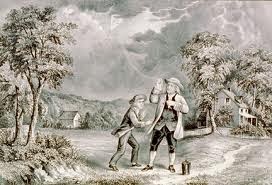
    Benjamin Franklin would be one of the most accomplished people of any age. He invented bi-focals and stoves, lightning rods and 'armonicas. He established lending libraries so that people could read, and fire brigades to help keep people and property safe. He was working-class and proud of it.

                                                   200 years later....


                  Ronald Reagan-
the 40th President of The United States.
             
Pretended to be a cowboy. For money.  Major work: Bedtime for Bonzo                 


           Considering the scope and influence of the United States, which of these men would you rather have in government?***
          Benjamin Franklin helped draft the constitution. He had ideas for experiments about lightning.
          Here's some idea of Ronald Reagan's own particular brand of explanation,nicely put into context by Afrika Bambaata and John Lydon:


               The question needs to be asked: Just how did the United States go from Benjamin Franklin to Ronald Reagan? The answer, as it is always the answer when considering stupidity, is: communication has been diminished.  Once a culture has achieved material success, the ruling elites will want to cement the current system. In order to do that, you must discourage communication.
                The communicative tide will invariably suffer attempts to stem it by various interested powerful parties. Massive amounts of monetary and intellectual expense are expended in order to stifle the only thing we ever do. Considering this anti-human assault on our natural state, It would only be fitting to describe those who attempt to hold back this natural tide as Cnuts.

              Despite Britain's loss of its American colony, the turn of the 19th century would see the British Empire continue to cut across the globe. The British elites would do very well indeed, living off the fat of the land of other people. In terms of money and power the British would win the World.
              It would be appropriate then, that the height of the British Empire would be overseen by the Victorians.


* but only if you were white of course.
** as a great example of how any information  can give very different ideas, I recommend this site, which also offers "common sense."                             
*** or making movies, for that matter.
                

Thursday, 26 September 2013

The Pope's no to the People's yes. The tide of British History. (2)

                                             Newton's telescope and...

                                             Hooke's microscope...
                                                      
as above, so below ?

        The year of 1660, saw the restoration of the monarchy with the crowning of Charles II. A country still dealing with the grinding of great religious tectonic plates and over ten years of Cromwellian puritanism accepted the new king as a necessary stabilising force.
         The English tree of knowledge sprang forth refreshed; as 1660 also saw the founding of The Royal Society, or, to give it its more explanatory title:  The Royal Society of London for the improvement of Natural Knowledge .  
         England may have had a monarch once more, but the tide of communication could not be stopped.  This is evidenced by The Royal Society's motto: Nullius in verba (Take nobody's word for it.)  The idea  now  was to gain knowledge through experiment. The idea of simple authority as the arbiter of things, for so long a mainstay of all human culture, was beginning to slowly drown beneath the wash of new ideas.
         One of the aims of the Royal Society would be to continue the work of Francis Bacon, who was hugely influential in developing what would become standard scientific methodology: starting with a hypothesis (an idea that offers an explanation of something), you conduct experiments to gain information to support your idea. 
        Science became better communication. God might refuse to answer questions, but the Universe much more generously began to spill her secrets once engaged in constructive conversation.
        As the reign of the the merry monarch took shape, the natural philosophers of the nation were merrily digging up new information and new ideas using the latest technology. Isaac Newton developed his telescope and used it to reflect his theories of gravity and planetary motion, while Robert Hooke would publish his book Micrographia, which contained drawings and notes on the  world of the small that had previously been hidden in plain sight:

          Johnathan Swift would express the new, dizzying vistas being opened up with-                             
                                So nat'ralists observe, a flea
                                Hath smaller fleas that on him prey;
                                And these have smaller fleas to bite 'em
                                And so proceeds ad infinitum.


        As the 17th century drew to a close, people were reaching the conclusion that, in a land of many religious ideas, tolerance might be a good and practical idea. Charles II himself was of this view and 1689 would see John Locke write his "letter concerning toleration" .
        Fine words unfortunately are apt to achieve little without action, and the kind of people who push tolerance only for their own beliefs became very worked up by the ascension to the throne of James II in 1685, because of his Catholic tastes and perceived French friendliness. This agitation  would result in the glorious revolution of 1688 when William of Orange would lead a Dutch invasion fleet as he was welcomed by his English supporters.
        John Locke could be criticised for being slow to publish, but the fact remains that the simple seed of tolerance is, in all places and all times, often difficult to cultivate. It is impossible to cultivate without better communication.

        There would, however, be some successful harvesting of tolerance as,  no longer wasting as much time arguing or fighting about how best to praise God, the British entering the 18th century were now set free to fervently worship Mammon.
      
                                          Mammon: always plenty of interest.

    As the century turned, the newly formed Bank of England, would funnel the necessary cash to re-build England's navy after recent defeats to France. This re-armament, along with the boost for associated industries, would show the great financial importance of a strong attack force. (In more modern times, this kind of economic model would have to be sold to the people as defence, an illuminating example of linguistic legerdemain. Of course, if you train people not to ask or check, then this kind of thing is a whole lot easier).
    The 18th century would see the first turnings of the Industrial Revolution as time and tide would combine to produce new wonders, technological marvels,  and basically a whole lot of  machines that would spin gold.
    All of this industry would be floated on the new freedom of information. The first years of the century would see the first daily newspapers begin to be published in England. Not long after, the fruits of the new science would be the likes of the steam engine, the mercury thermometer, and the diving bell.  Science had enslaved Vulcan, and was challenging Neptune.
    During  this frenzy of invention the very country itself was forged anew as the Kingdom of Great Britain came into being in 1707.
   Naturally, people had to try to deal with this deluge of information and ideas, and, as always, human beings would create invented worlds that could mirror and reflect on what was happening in the real world.
    1719 saw the publication of Robinson Crusoe , and five years later Gulliver's Travels would be Swift's response to both Crusoe and the brave new world he represented. Both of these novels  would show men cast adrift and their struggle to survive in unknown waters.  Crusoe  is a more straight-forward tale, that can be interpretated as a description and vindication of the justness of Protestant Anglo-Saxon colonisation.  Gulliver's travel's, on the other hand, is a Houyhnhnm of a different colour, and raises the explanatory art of satire to new, Laputian heights.
     Gulliver encounters the tiny people of  Lilliput who have huge differences of opinion over which end of an egg should be broken first. You can imagine the hero's shocked disbelief mirroring that of a Japanese being informed that both Catholics and Protestants are Christians.
     And when Gulliver visits Laputa, he finds a society obsessed with science, but unable to turn it to practical purpose. (A reasonable criticism that is still valid today, as the defence industries still continue to dominate far too much scientific research).
      Swift was satirising the Royal Society and its random experiments, but a lot of valuable knowledge has been gained by people's natural sense of random experiment. Indeed, we often can not predict the results of our experiments, or even clearly explain where our own ideas have come from: Swift's own religious liberty flowered on the same tree of knowledge that was now producing new branches of science.
        
                                               Science: just pi in the sky?

  The natural worries of those like Swift would continue to occur throughout British history, and will certainly continue into the future. It was, and is, perfectly normal for science's scattered bags and opened, discarded cans to demand scrutiny. But the cats have long spread out and are breeding,  and the worms are slowly but surely burrowing into secret places. Communication's rise can be hindered but not stopped; and in the Britain of the 18th century, not just the British Navy's, but all the country's boats were being lifted and moved by the steady waves of commerce, intellectual freedom and technology.   
    Like all tides, the swell of the British Enlightenment might retreat for a while but it always came back strong again. It would push on around the globe.
    The strength of this massive liquid movement would eventually push great pieces of the tree of knowledge into the Atlantic and carry them across to the New World of the Americas. There, the tree of knowledge would be eagerly transplanted into new and fertile ground where it would flourish even better than before.
    For the natural culmination of Britain's tide of communication would literally require a New England.


Thursday, 12 September 2013

The Pope's no to The People's yes: The tide of British History. (1).


       '
                                             Henry VIII.- Hampton Court?
                                             No, it's just his new codpiece.


     In its history, Britain (largely England for this period) has been invaded by Romans and Normans, and bossed about by Angles, Saxons and Danes. It has been riven by religious strife and convulsed by civil war and revolution. So how did this "miserable little island off the coast of France" as Frank Zappa called it, manage to develop, by the 19th Century, into the greatest power in the world?
     One of the most important factors in tracing the development of British power is the English Reformation. This action would provide the broad root that would twist, turn and ultimately support the growth of the English oak over the next 100 years. For the step away from traditional thought freed up new information and new ideas,  and  growth is impossible without these things. 
     In 1527, Henry VIII asked Pope Clement VII to annul his own marriage to Catherine of Aragon, his first wife. The King was desperate for a male heir and wished for a new wife to provide that heir (ironic, considering how well his daughter Elizabeth would do as Queen.) The Pope's subsequent refusal led to Henry withdrawing The Church of England from the authority of Rome.
     The context of the times was the Renaissance, when there was an influx of ancient Greek ideas and scholars to Europe. Information, like type and people, had become much more movable, and following inevitably behind new information were new ideas:


       The English Reformation would turn out to be one of Henry's most important children. With the Pope no longer able to influence England, the country had gained a powerful and important independence, it now had the freedom to explore many new avenues.
    So it was, with the death of Henry, England, in its wisdom, crowned his 9 year old son as Edward VII.   
     During young Edward's six-year reign Protestantism was firmly established as the ruling creed. Until a few years later when Bloody Mary, happily burning Protestants at the stake,  re-established  Roman Catholicism as the correct and Holy ideas to live by.
     All of that would, in turn, be reversed when Mary's half-sister became Elizabeth I in 1558.
     After this swaying back and forth between the religious poles, Elizabeth's reign would provide a fortunate period of stability that allowed more growth.
     The maelstrom of swirling thought created by the previous monarchs produced  waves in the culture great enough to support the rise of English drama. The great writers of the time naturally produced works that addressed recent history, and Shakespeare in particular developed stories and characters that spoke to, and of, the swirling information and ideas of the times:
 
              
                 "O Wonder! How many goodly creatures are there here.
                         How beauteous mankind is!

                              O Brave new world that has such people in't!"

        Independent of Rome, the beauteous English would use their new freedom to attack the other great powers and their allies and holdings. For people from Plymouth to Newcastle, the famous sailor Sir Francis Drake would be a national hero. In Spain he was simply described as: "a pirate." International affairs remain broadly similar today.


    After Elizabeth came James I, whose patronage of the world of letters would produce the most famous translation of Christian scripture: The King James Bible.
    The information contained within the most important book in the country was becoming freely available to all who could read. Naturally enough, this new bay of information combined with all the religious earthquakes of the preceding decades to produce a tsunami powerful enough to wash across the land, leaving strange new sects and never-before seen cults wriggling in its wake.
     Those referred to as Puritans would flourish in this fertile ground of early 17th century England as bishops, ministers and lay-people all argued over the correct interpretation of God's word. This tide of un-orthodox thought would eventually rise high enough to engulf the Crown itself;  Charles I would reign in a land which had moved on from asking: Do we need a Pope? to: Do we need a King?
     Charles didn't help his own cause by exclaiming: "Kings are not bound to give an account of their actions but to God alone." On an island now set in surging seas of increased communication, James' refusal to explain himself set him firmly against the tide of history.

     The English Revolution of 1640-1660 saw the execution of Charles I and  Oliver Cromwell take power. His governance of the country would be essentially fascistic with his belief that, guided by God, he should oversee a land where: "A nobleman, a gentleman, a yeoman, the distinction of these: that is a good interest of the nation, and a great one." Domestic affairs remain broadly similar today.
      Fascists are fundamentally anti-communication, and Cromwell ordered the closure of all the theatres to ensure that no naughty and satanic ideas could fester on the open stage. Laws such as this, as well as those preventing the celebration of Christmas and the playing of football on a Sunday would, in fact, quite naturally only ensure that the country would eventually tire of Cromwell's reign. The nation would sway back again towards the crown with the restoration of Charles II.
      Britain, by the end of the 17th Century was profiting from conquest and trade and had a culture that had evolved to cope with a plurality of views. It was a place where describing and explaining and asking and checking  were practiced as much as anywhere on the planet, and this gave it the right soil from which could spring the first shoots of modern science.
      The bonds of religion, loosened throughout the previous 100 years, were now lax enough to allow many cats to slip out of all kinds of bags.
      And all around the country, the natural philosophers were busy opening cans containing all manner of worms.
   

Wednesday, 4 September 2013

Love is like Phlogiston - science as better communication.

                                         
                                                    Sophia- Pneumatic

       Every year, between the start of July and the end of August, Japan's Mt Fuji is alive with city-dwellers determined to conquer the famous peak. At this time, the shops on the slopes of the volcano do a roaring trade in small cans of oxygen as even the most unenlightened of Tokyo troglodytes recognises the need for this vital gas to keep our body working.  
         If, however, you were attempting to climb Mt Olympus in ancient Greece and felt the same need for a shot of 02, the locals would probably politely suggest that you suck in some of the plentiful supply of pneuma that is all around you, as that's clearly all that a body needs.

                         Communication is always INFO ---------> IDEA

          Wherever we may be from, all of our ancestors long ago looked up at the Sun, the Moon and the Stars and tried to offer each other explanations.  Understandably, considering the demanding circumstances of their lives, these explanations were largely about a god or gods who were quick to anger and whose opaque schemes for human-kind were largely inexplicable. Given the information they had to work with, I can only admire their ingenuity in coming up with anything at all.
           And yet, at the same time, these people were naturally developing certain techniques and methods that would serve them brilliantly for survival. They learned how and where to catch food and which plants to eat or use as medicine, as well as developing cultural ideas and habits that would contribute to the prosperity of the group. They were successful largely because they communicated knowledge to each other and to the next generation. Human beings over time developed the four most basic tools of human communication:-

                             Describing + Explaining + Asking + Checking


      Of course, it is much easier to use these tools when you are not worrying about food or the proximity of sabre-tooth tigers to your infants. So communication took great leaps and bounds when societies were forged that allowed people the time to just sit around and think and to be able to discuss their ideas at length. In  places like ancient Greece, where farming had led to the development of civilisation, people began to propose ideas about how things worked that went beyond formerly simplistic explanations like: "It's God!".
    Theories about the human body and society and the mind were all described and explained as fully as was possible, as reason and inquiry were allowed to flourish and philosophy was allowed to grow.
     Philosophy or the love of wisdom, may be best described as: trying to understand how things work. Defined like this, it allows us to see that philosophy is vital to human survival and prosperity. The desire to understand how things work has given us all the benefits of modern life.  Also, we can understand that throughout history all cultures have basically sought the same targets of philosophy: survival and prosperity; so that we should not consider philosophy to be only the sport of ancient g(r)eeks.
             For philosophy you need to communicate, and we are all born with the ability to communicate. Philosophy is our birth-right. It is our cultures that strip this from us. Gradually, over human history, our cultures have become more tolerant of communication, more welcoming to philosophy, but it is still early days considering the possibilities before us.

          
           INFO--------> IDEA  therefore  more INFO--------> more IDEA

          
                                              What's the bleeding time?
 
                                    
        England, at the end of the 17th Century, thanks to some lucky accidents of history and certainly not to any superiority of English blood,  was enjoying the fruits of its empire. One of the most succulent of these growths upon the tree of knowledge would be the development of what is often referred to as the scientific revolution.
        Using a commercially-available microscope, the English Physician William Harvey observed the hearts of insects acting as pneumatic pumps. From these observations of our tiny cousins, Harvey developed his theory of blood circulation. It is sobering to consider that a reasonable theory of how our blood works within us is only 300 years old.
        Any theory is most simply an explanation. If people are communicating effectively then any explanation will be naturally met by questions asking for more information or checking an idea.     Harvey was able to provide the information gained from his observations with the microscope as well as describing and explaining how blood flows by way of experiment. The use of an experiment allows other people to check the information and the idea. The modern practice of science requires describing and explaining and asking and checking as standard. Thus it can be seen that "the most precious thing we have " as Einstein said of science, describes as well our best efforts to communicate.

            This dawn of reason, this era of Halley, Harvey and Hooke, would come to be seen as the time of transition from alchemy to chemistry; when natural philosophy became science.  But, whatever you want to call it, it seems fair to say that, most basically, the explanations got better.
         In 1667, a learned person attempting to get the better of any mountain in Japan or Greece or anywhere, may well have wondered about the new-fangled theory of Phlogiston as they attempted to light a fire to keep warm on the slopes. This theory attempted to explain what happened during combustion by describing an element called phlogiston that was responsible for how well things burned. Until the end of the next century, phlogiston would provide the best explanation that people could come up with.
        The phlogiston theory would sputter on for a hundred years until the French scientist  Antoine Lavoisier  defined both oxygen and hydrogen and his experiments involving H2O would help explain how it was that oxygen  was the key to understanding combustion.
        Phologiston's spark was no more, ironically snuffed out by oxygen.  Lavoisier himself would meet his own fate at the mercy of a Revolutionary court, that would see fit to put him to death for the heinous crime of adultering the nation's tobacco supply. With water.
       
      If we wish to avoid a future where knowledge and information is feared and those who seek to understand and explain are considered too dangerous to live, we must encourage science.
      Science, however, can only flourish through better communication. Whether it be improved instruments to provide better information  or encouraging a culture where people can ask questions or provide alternative explanations without fear of an inquisition,  science, or indeed, the love of wisdom is most simply an ongoing conversation with the universe.
         As the universe is a little shy at times and reluctant to explain itself, doesn't it make sense for human beings to be encouraging as many people as possible to be involved with this conversation? As one of the finest examples of the only thing we ever do, science is way too important to be left to just those who get paid for it. Or those who seek only profit from it.


                                      According to Sweet, Love is like Oxygen. 


Tuesday, 23 July 2013

Call Social Services- British society has long-term plan to abuse newly-born child.


                                                    Happy Birthday !

           The new British Royal Prince has barely been on the planet 24 hours but he has already been put to work. His job as Prince (name) of Cambridge has already been decided. Isn't this compulsory labour ? Won't his child-hood be shadowed by the expectation to act according to his job?  Shouldn't we at least ask him if he wants to be a Prince?
           Not satisfied with child exploitation, British society will be grooming him for his future job that, in all probability, will be 40 or 50 years from now. It has already been decided that, at some point in the future he will become King. And we expect him to be King until he his dead.
          So that's the little fellow's life mapped out for him then. How kind of us. No wonder we can't contain our excitement.

          Before catching his first breath, before any chance to look around or smile at his mum, it has been ordered that this child's natural abilities and hopes and desires will all be subsumed to the role that we have already decided for him. It will not matter if he dreams of being a footballer or an artist, or of living in a cave in Scotland. We know what we want, and his wants don't, and won't, come into it. Isn't this just a bit cruel?

           Clearly, Britain likes having a Royal family. The phrase is often heard that our Royal family makes you "proud to be British." Are we really proud of bullying infants and encouraging a culture that suggests some people are born special and others are not ? Doesn't this kind of culture positively reek of Naziism?
           But, how can this be when we are taught so clearly that the plucky Brits stood firm against the evils of Hitler ?
          
           As always, information gives idea-

                                 Herr Hitler invites us into his lovely home.


           This is from the November 1938 edition of the British magazine Homes and Gardens. The article takes us Hello-style through the sophisticated living quarters of the man who that very month was to order Kristallnacht.  Corporate Britain of the time didn't seem to find too much disagreeable in the "droll raconteur " who kindly gave a "fun-fair" for local children.

           Corporate Britain of now, sees nothing disagreeable in the current system that happily robs a child of his possible dreams even before his umbilical has been cut, in order to perpetuate a society where we are allowed tantalising glimpses of the top of Mount Olympus thanks to a media that exists to make a profit from the gods that they create.
            And all of this made possible by a culture of anti-communication.

         The Nazis
were very big on anti-communication.
        
I thought we won,  didn't we ?
 

Monday, 22 July 2013

Kirk Douglas, Frederick Douglass, and Teofilo Cubillas : education = how things work.


                                       Pour encourager les autres.  

          In Stanley Kubrick's film Paths of Glory, Kirk Douglas plays a World War 1 French Colonel who refuses to obey a suicidal attack order. The Top Brass deal with this by choosing three soldiers at random to be executed. Within the system, the lower orders must obey the orders of their commanders no matter how ludicrous they are. For if the command structure were to falter, who knows what might happen?
          Simply put, if command structures do break down then communication will break loose. It is in order to keep the beautiful twin beasts of describing and explaining in their cage that events like those depicted in the film have occured, and continue to occur, throughout history. Describing and explaining are not a danger to us, they are a danger to those in power and those that serve that power, and that is their threat. At the same time, Bela Lugosi must remain buried, his head severed from his neck, to ensure he does not rise and give blood and energy to the living.
          Information like that of Paths of Glory helps people to understand how things work, and powerful people don't like it. After its release in 1957, the French Government put pressure on distributors to ensure that it wasn't seen, and was only released in France in 1975.

                         "People who understand physics understand the way it works. If they want to bother with the details they'll look them up. Pretty much the same is true about understanding the world. Education is a system of imposed ignorance. It is a system of indoctrination. It is a system which drives out of you a lot of the capacity to understand things."
                                              - Noam Chomsky.

        
Three years after the French people were finally deemed fit by their government to watch Paths of Glory, I was watching my first World Cup. It was a very different time, because not only was Scotland one of the 16 teams competing, their manager had gone on record stating that Scotland could win it.
          Naturally enough, I settled down to watch the first game against Peru expecting Scotland to show these primitive people a thing or two. I remember someone mentioning that some of the Peruvian players didn't know how old they were. What kind of place was it were people didn't know how old they were?  Surely and steadily, the world cup began to drip interesting and strange information. Especially when this kind of thing started to happen-


              Peru, dismissed by many commentators beforehand, turned out to be brilliant. Later, I would wonder about why it meant so much to Austria to beat Germany and about the mysterious way that Peru fell apart to lose 6-0 to Argentina, when the hosts happened to need a 4 goal victory to advance to the final.
              Even later, I would realise that throughout the tournament I had not once heard the simple fact that Argentina was a military dictatorship that was actively disappearing people.  Why wouldn't people mention this information? Do people suppress information because their culture demands it? Is this how things work?

              99 years previously to the Argentina World Cup , another man who didn't know when he was born was meeting his former owner. This man was the freed slave Frederick Douglass.
                                         

                  When Douglass was 12 years old, the wife of his owner began to teach him to read. Her husband was enraged by this act, explaining that, if slaves were to read, they would be dissatisfied and want freedom. In fact, it was illegal to teach slaves how to read. This was how things worked in the U.S. at that time.
                  People were denied information because it might give them ideas.


               Douglass eventually became an important abolitionist and, simply through his power of communication, ensured that otherwise ignorant people could behold an ex-slave who was as intelligent and articulate as any man.

                   Yet the United States today still has many problems with race relations. The efforts at communication that Frederick Douglass made have consistently been lassoed and hog-tied by the powerful groups who care only for their own profit; who can not recognise the natural and fitting beauty of describing and explaining, who can not understand that Bela Lugosi is not a creature to be feared, but is instead ourselves, our own true selves, and any society that buries and fears its own true self will eventually find out what grows on the grave that we have buried our own souls in.

                    The Pentagon has twice as many bathrooms as it needs.


                   Modern U.S. race relations are explored in the brilliant television show The Wire. It should be noted that this drama attempts to describe and explain how things work in a society like the city of Baltimore in which it is set. It is blatantly clear when watching the show that this kind of art on TV has consistently been as rare as a Snow Leopard. And, in a society of commodification, is becoming increasingly rare everywhere. 
                 In interviews, David Simon, the creator of The Wire, has talked about the influence on his show of Paths of Glory.
                Information gives ideas.. And logically, better information, for example: better stories, give better ideas. That's how things work.


Thursday, 11 July 2013

Ex-nymphs vs sex-crazed homos: Describing and Explaining.


                                                         What is it?

          The part of communication that is giving information can be most easily expressed as: Describing and Explaining. We describe and explain whenever we give information, and from this information there is an idea, because communication always, and most basically, works as:

                                             Information ---------> Idea

       
The information we choose to give affects the idea. We might describe former P.M. Tony Blair as "the right honourable", or we can describe him as "a war criminal." The musician Prince has been described as " a supernatural Martian playing at Euterpe's party" as well as "a paranoid little schizo with a bible in one hand and his cock in the other." And even such a relatively simple scenario as this-


        -may be a woodlouse, a butcher boy, or even a 団子虫(dango mushi) or dumpling bug in Japanese.  Would you rather have a louse or a dumpling bug in your house?
       
       All people are born with an innate desire to describe and explain. Without it we couldn't learn our native language. Education generally spoils this natural ability by having a deadening culture of the right answer. Things have become worse in the last couple of decades with the increasing emphasis on mulitiple choice tests-   http://www.edutopia.org/blog/dark-history-of-multiple-choice-ainissa-ramirez
  
     Here's a quick multiple choice test:
Q: The Sun is best described as:

A: A Star.
B. A god.
C. An organ.
D. A yellow dwarf.

    Yes, The Sun is a star. But it is also a god and an organ and a yellow dwarf. A vital aspect of communication is that all information depends on context. In different contexts, the Sun is all these things. Communication problems occur when people are connecting information to different contexts. This is why very basic communication practice involves defining terms.
    Here's George Carlin's perfectly sensible view of the sun: Sun God.


Looks like the Japanese were right all along !

   
   Fundamentalists of all kits, as well as despising Bela Lugosi, also dis-like describing and explaining.  We are told that: "God moves in mysterious ways" (so don't look for better explanations). We also hear very clear statements that in themselves demand more explanation because the idea that follows information is itself information that naturally leads to another idea. That's the way it works. Don't blame me, blame: god/evolution/explanation of choice.  
    For example: what could be more worthy of explanation than the reason why the United Kingdom needs nuclear weapons? Clearly, the ancient and wise Great Britain would find someone who would patiently go through all the necessary explanations to show people why they should spend their money on things that are built to do this-


-rather than spend the money on things that can do this-


         Clearly, it's a tricky choice that ordinary people can't be trusted with. The British democracy  entrusts this sacred choice with a member of the educated elite who can guide us through this maze. Do we want children burnt to hell or reading books? Luckily, here's Dave to show us the way- David Cameron: We need a nuclear deterrent more than ever
        As reading is now officially something not to be encouraged I'll go through the main points in Dave's explanation-

         We need a "nuclear deterrent" because countries like Iran and North Korea are a threat. North Korea is described as "aggressive".  Presumably, that's more aggressive than our good friend and invading partner the United States that has invaded many many more countries than North Korea in the last few decades. Of course, nobody asks for Dave's definition of aggression. That would entail better communication and people are educated not to do that.
         Also, there is absolutely no explanation why countries like Sweden and Brazil and Switzerland feel that they are fine without any nuclear weapons capability whatsoever. Moreover, there is no effort to explain the benefit any country would gain from attacking Britain with nuclear weapons anyway. If we decommissioned all our nukes tomorrow, would Russia immediately attack? If they wouldn't, then why do we have nuclear weapons ?
        
          How did we get to the point where we accept the feeble explanations of a shiny-faced toff as to why we should turn our ploughshares into swords ?
          The current economic system that Britain is a part of demands weak communication. If the power structures that we already have are to survive, they must ensure that people are not interested in asking and checking or demanding better describing and explaining.  This system results in an educated elite that are not taught how communication works but know enough about describing and explaining to realise that it serves the interests of those in power if communication is a one-way street.
           An excellent example of what can be done with top-down communication is in the BBC documentary The Century of the Self, which profiles "the father of the Public Relations industry" Edward Bernays-          http://www.youtube.com/watch?v=cW_rIdd69W8
   The Public Relations industry is essentially against better communication because it makes their job more difficult. They like simple describing and explaining that puts a simple idea into people's heads. They prefer very much that Bela Lugosi's coffin lid is nailed tightly shut. Modern politics and culture is broadly the same. With simple explanations you can show people ideas that appeal. All the while obscuring more useful information that would give us a more useful idea. It would have been useful information for many people in 1981 to know that members of  Thatcher's cabinet were idly suggesting plans like 'managed decline' for a major city like Liverpool. We only get to hear about it 30 years later. Who is this information being kept secret from? The Russkies? Or us?
       
          The information we give affects the idea. The world now has many more PR people who's job it is to manage information in order to present only certain ideas. Would you prefer ex-nymphs in your garden or sex-crazed homos? Of course, personal preference comes into it, and I don't doubt that some people will be intrigued by the idea of either  a garden full of rampant gays, or unemployed  goddesses. Or both.
           However, my own idea of this information is this-


             The cicada or せみ(semi) or, tree-cricket or, that thing that makes enormous racket, lives for years as a Nymph. It used to be considered Homoptera, which means "uniform-wings". Interestingly, this explanation is no longer considered good enough. New information became available and the idea has changed.
          You can look at the information of a cicada and get many ideas. You night consider them grotesque or soothing or annoying or interesting. But when a cicada emerges as an adult it has only a couple of weeks to find a mate. So it sings. A lot. Fair enough really isn't it? If you had as little time, you'd want to make some noise too wouldn't you?

              By the way, How do we ourselves define " little time."?


Erm, so...how does language fundamentally work? - -----------------------------> Fuck all that we've gotta get on with these!

                                                Judge Dredd might not know a lot about art,                                               bu...