Thursday, 7 December 2023

"And do the other things" - Kennedy, Context and the Matrix.


Around the time of the anniversary of Apollo 11, or of the famous assassination in Dallas, the clip of President John F. Kennedy talking about going to the Moon has often been wheeled out:


Ever since I saw this for the first time, maybe 35 years ago, I was always slightly baffled by the phrase: "We choose to go to the Moon and do the other things, not because they are easy, but because they are hard."

What does "and do the other things" mean, I wondered? Why did Kennedy just presume his audience would know what these other things were? Or was it some sophisticated rhetorical device that I was unaware of? Should I start using it to give whatever I was saying some much-needed gravitas?

However, just last week I happened upon a fuller version of the speech:


Clearly then, the other things are referring to the climbing of Everest and the flying of the Atlantic, conquering the challenges necessary for progress. 

With context, it is obvious what "and do the other things" is referring to, and here is the point: we can get a better understanding of anything by understanding its context. However, it is not usual for people to even acknowledge this.

It is worth reiterating then, that: we can only understand information by its connected ideas, and that any information is embedded within a web of connections of information and idea(s) that constitutes the actual matrix that we live within. 

That matrix includes sushi recipes, computer networks, and The Matrix.


It can include anything, as the context of anything is everything. In communication, the fundamental organic process ensures that communication is always both incredibly simple and dazzilingly complex at the same time.

The fundamental process is always:


which, as any idea is basically information, is always immediately recursive:


however, like a stone cast into a pond, any first step of the fundamental communicative process ripples out in all directions:
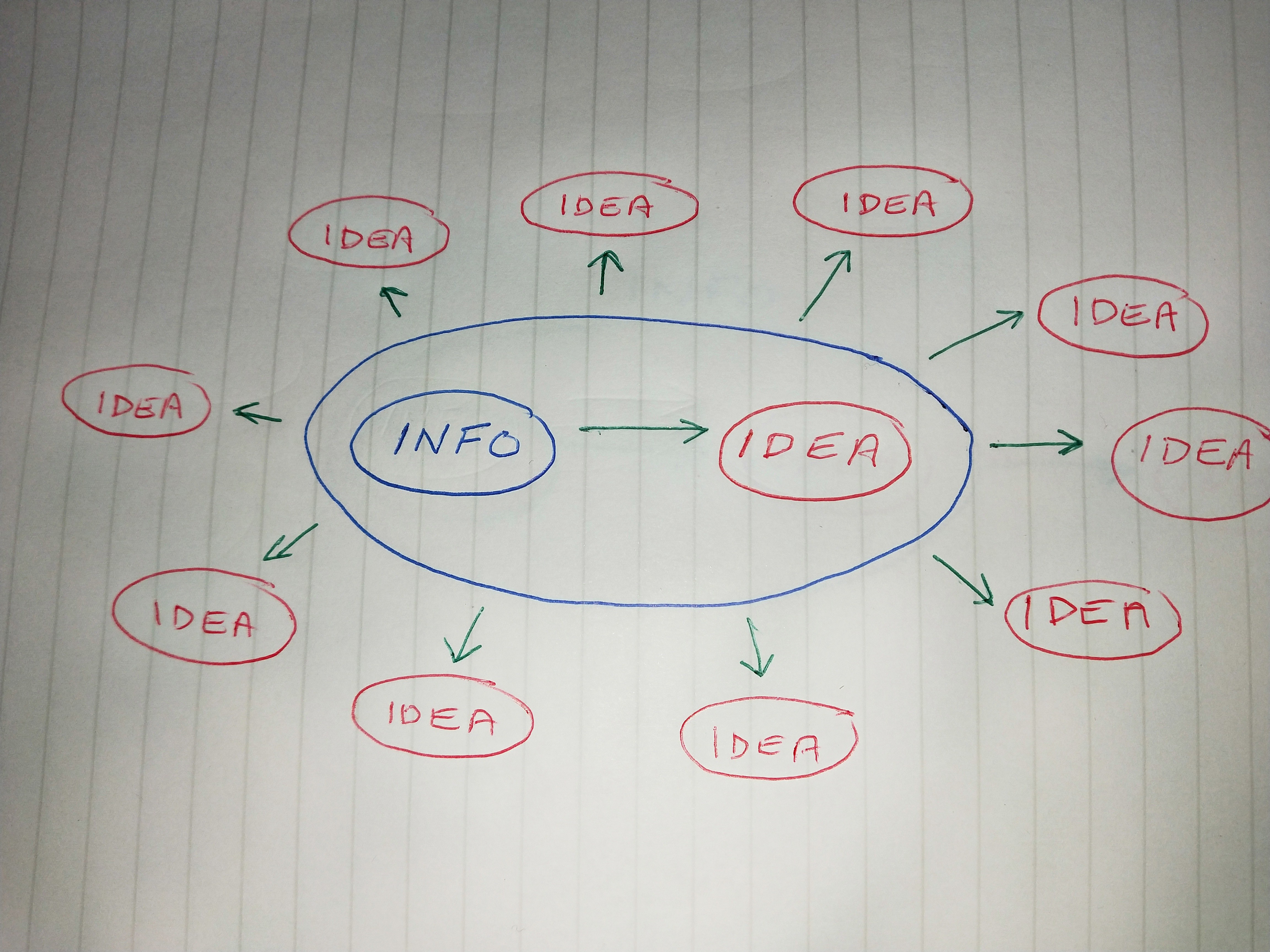

and all those strands, themselves recursive, continue the process:


and so on, beyond the edge of the page, into the realms of fiction and imagination:
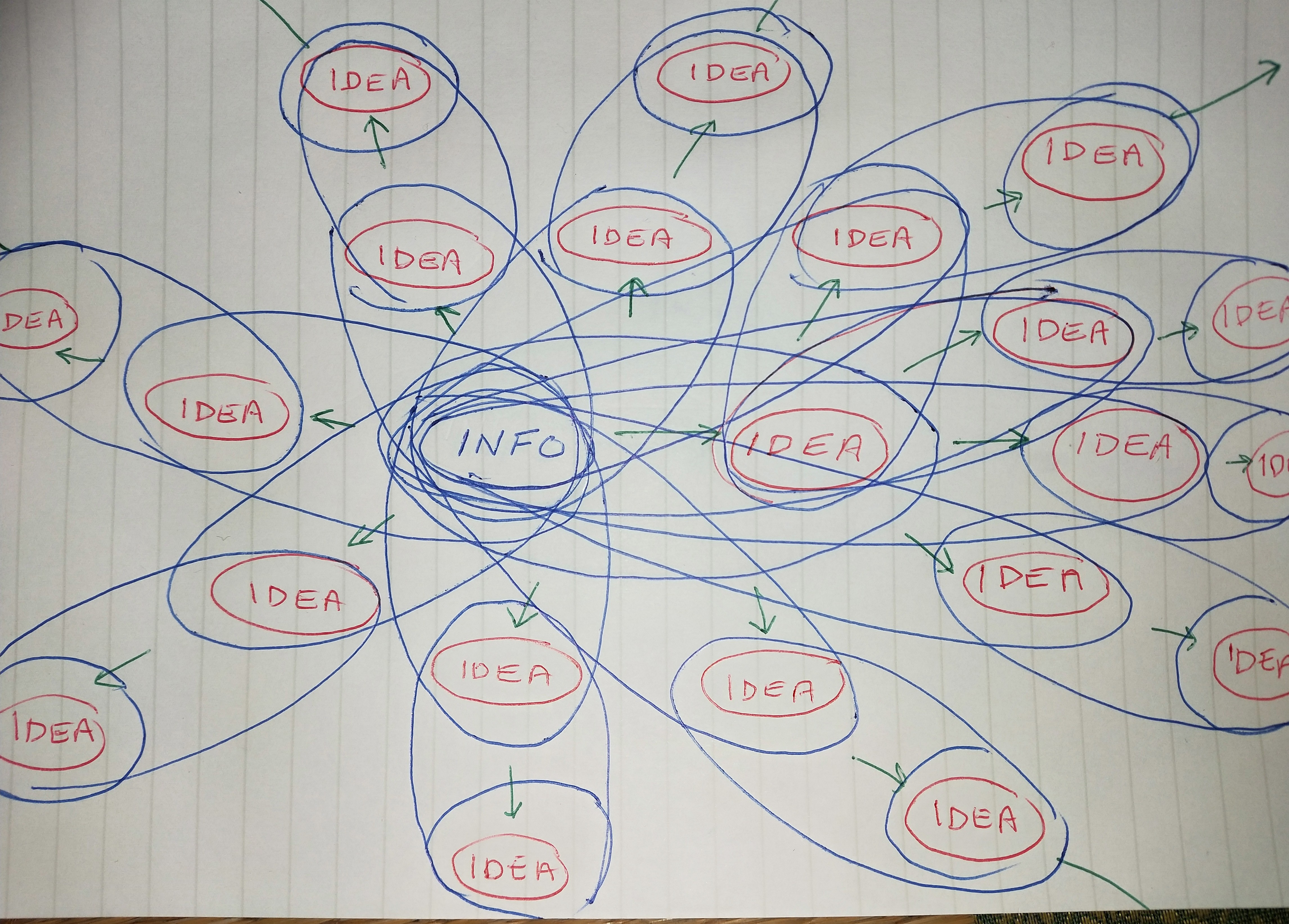

allowing us to understand that the context of anything, the matrix in which we all reside is not just this:
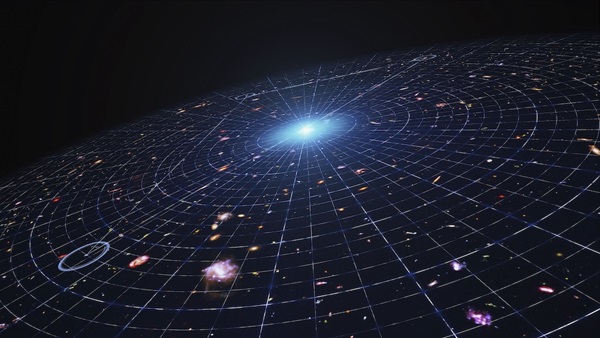

but also this:
this: 

this: 


and anything else you can think of... as well as everything you can't.

How then, are we to make sense of anything?

Happily, the process of evolution has allowed us a brain that, while constantly computing millions of points of context without any conscious oversight, allowing us to do achieve such dazzilingly complex tasks as walking to the shops, also has the capacity to sort information out by cutting out those connections deemed unnecessary. In short, we can ignore possible connections in order to arrive at the most useful. 

The immediate context.

To take an example, remember this guy?


     Joseph Kony, abductor of children, leader of child soldiers, wanted in Uganda for various atrocities including rape of young girls, and abducting them for use as sex slaves. 

In 2012, a short documentary film about him and his crimes entitled Kony 2012 became the first video on YouTube to gain 1 million likes. It is estimated that nearly half of American youth were aware of the video within a week after its release. The video called for action against Kony, and celebrities including Justin Beiber, Bill Gates, and Kim Kardashian, lined up to endorse the cause. 
Although it received support, others with a more in-depth knowledge of the situation rightly called it out as slacktivism, with one specialist ponting out that the simple solution of just raising awareness is  "a beautiful equation that can only work so long as we believe that nothing in the world happens unless we know about it ... only works in the myopic reality of the film, a reality that deliberately eschews depth and complexity."

So, in terms of information ------> idea:

Joseph Kony, evil man ------------> put a sticker up in your school.

Kony + sticker -----------------------> I feel good.

The only way that we can understand anything better is by asking and checking. The only way to get more context is by asking and checking. 

What happened to Joseph Kony?

Nothing.

As of 2023, it is thought he remains in hiding in Darfur.

The Kony 2012 example also serves to illustrate how the new media, the Facebooks  YouTubes, and tik-toks, providing simple pleasure as they are designed to do, (Former Facebook executive says Facebook designed to be as addictive as cigarettes), are contributing to a general cuture where less thought and effort is given to try to understand anything better, as locked in as we are to immediate gratification and the increasing economic satiation of our most basic animal needs.

Of course, human beings have always been like this. Our most basic operating system is the same as the other animals, where any information is immediately plugged into ideas of emotion and sensation. However, we do have the capacity for asking and checking (to get better describing and explaining) way beyond our fellow creatures, but the fact remains that it is generally discouraged, and specifically inhibited in education as demonstrated by the complete lack of any formal importance attached to the practice, testing, or grading of asking and checking.

Our ability to wield questions to help us cut through the forest of information we live in has allowed us to get this far. Better communication, of which asking and checking is the foundation, is behind all improvement in human history.

Why stop now, just when things are getting interesting?

--------------------------------------------------------------------------------

Down the memory hole: other things


They got them back, right?.


In 2000 the High Court in London ruled that the Chagos Islanders forceably removed from Diego Garcia should be allowed to return. Which knight of the realm, commited Christian and peace envoy, in cahoots with the Crown, took action to ignore this ruling?


Could another Prime Minister express such self confidence in mocking the idea of Long Covid with a complete ignorance of another debilitating disease? 

Mind you, it was always thus, and as more context becomes available we can get a clearer idea of the people we allow to rule us:

 
Well, ok. But it's not like he was in Dallas the day of the Assassination, right?

Sunday, 18 June 2023

Any Count could do it: Asking and Checking.

 "The only way we can begin to try to understand anything better is by asking+checking."


If that statement is true, then you might think that it might be widely accepted, that, say, asking+checking practice for stidents might be eagerly accepted with open arms. 

You would be wrong.

Traditionally, no culture, no education system, makes any formal effort to encouage, practice, test, or grade asking+checking.

The reason for this is very simple: any unjust power structure must inhibit communication, to a lesser or greater extent, in order to protect itself.

Consequently, what we end up accepting is a world where understanding things better has no common currency, so that questions people should naturally have been asking in their schooldays bubble up years later. And because we lack practice with questions, just asking one and getting an explanation that is novel can be a profoundly moving experience :

"What if the moon landing was a hoax?"

The following is my answer to the question How do you instantly shut down a "the moon landing was faked" debate? on the website Quora:


Don’t debate. Don’t attempt to convince or persuade.

Don’t offer your own descriptions and explanations of the event in question.

Instead, ask them these 10 questions:

(All questions are: According to NASA)

  1. What was the first Apollo mission in space?
  2. What was the first Apollo mission to orbit the Moon?
  3. What happened to Apollo 12 shortly after liftoff?
  4. How many Apollo missions landed on the moon?
  5. How many men claimed to have walked on the Moon?
  6. What did Van Allen say about the danger to astronauts from the radiation belts named after him?
  7. Why can’t we see stars in the sky during the day, like at night?
  8. Why can’t the far side of the Moon ever be observed from Earth?
  9. What is the distance from the Earth to the Moon?
  10. When Armstrong and Aldrin were on the Moon, what space-ship event could they have witnessed at Mare Crisium?

Predictably and inevitably, they will not be able to answer these questions.

At which point, it seems fair to say:

You don’t know what NASA is claiming, so you certainly can’t say NASA is wrong.

To be clear, these events, that you clearly know fuck all about, you’re saying these events never happened?

The point here I think is worth emphasising: people denying the Apollo landings have no clear idea of what it is they are denying. It is as though a stranger were to tell me they had visited the top of Mt Fuji and I were to immediately deny it because: it's a volcano!

All understanding is basically

 information→idea,

so, it follows that:

better information→better idea, 

and the only way to begin to try to understand if information is better or not is by asking+checking.


In that spirit then, you are free to take the information here and connect it to the idea of: a big load of rubbish.

But, to check, you would be doing that without askIng+checking, wouldn't you?


Tuesday, 1 December 2020

Martian Elephants


      I exhibited Martian elephants, at the pleasure grounds 
      where the bands and circus played.

      No clowning for us, but a great feat of science,
      from dream to plan, with tool and appliance,
      some 25 years of traveling in place,
      then a carbon-based Elevator to take us to space.

      Geodesic dome-home and dust-devil friends,
      six-eighty days (or a year) (it depends).

      Then found them! and quickly discussed guest disgust:
      No hunting, no chains; their family united,
      no cages at all, for they were invited.

      Between worlds we flew, and, taking our cue,
      planetary break, from red on to blue 

      Greatest Show on Earth! The posters went up.
      One time only! A mile from this station!
      Free parking, free programmes, three groats a head,
      fifty pence extra to see them all fed!

      St John, Old Bill, and The Queen's PCA,
      Sol with his hat on, to brighten the day. 
      Pleasure to share miracle existence!
      From fields of Mars: pieces de resistance!
      
     The gates opened at ten to the sound of...
     ... cricketers, playing just over the boundary.

     Nothing, nobody! Greatest No-show on Earth!
     Not one single person can value their worth?

     Baffled, and boiling with anger and rage,
     What madness of crowds keeps wonder encaged? 
     Thirsting for knowledge I went into town, 
     to stop shopping pachyderms, glazing around, 
      
     Their answer they trumpeted, happy and clear:
     Mate! cease your questions! and be of good cheer!
     calm down and allow us a word in your ear:
     we've all seen elephants before, round here!


Friday, 21 February 2020

The Invisible Collage : how language is pasted onto the most basic surfaces of our thoughts.

col·lage
 (kō-läzh′, kə-)
n.
1.
a. An artistic composition of materials and objects pasted over a surface, often with unifying lines and color.
b. A work, such as a literary piece, composed of both borrowed and original material


   What?


Which.....?                                           What kind of....?                      


Who?               Where?

Whose?   


How?


 Why ?


           To see a World in a Grain of Sand
And a Heaven in a Wild Flower
Hold Infinity in the palm of your hand
And Eternity in an hour
                                       
                                           - William Blake

       
      The astonishing worlds and heavens and infinities of human  language  araise from very simple materials on a very simple canvas. So simple, in fact, that we all, as children, take these materials and proceed to produce fine art  upon the canvas without ever being formally taught what to do. This innate capacity for the magic of creativity tells us what we are, while also explaining why the power dynamics of human cultures has traditionally tended towards inhibiting our most basic abilities.
     That this human capacity is within everybody and is responsible for the everyday miracle of human communication, the staggering sorcery that small children produce with a wave of the tongue, has largely been ignored, and much of linguistics has tended towards the mechanical and easily observable.  The invisible collage that we actually use to paint the world remains hidden behind curtains of verb phrases and Umberto Eco's arras.                       


    The fact that human beings are born with both the capacity to ask questions and also answer those questions is a truth so self -evident that the study of language has tended to ignore it and focus instead on the refined and fancy parts of speech like articles and particles, as well as the grand and clever-sounding concepts of such well respected members of the academy as semantics and semiotics.
     However, much as if the study of how human beings walk had decided to focus exclusively on skin and muscle whilst ignoring bones and the brain, there is a lot to be gained from peeling back all the nouns, verbs and discontinuous signifiers and having a look at what lies beneath, and where the connections lead to.


     Whoever you are, and whatever language you speak, you share with everybody else on the planet the same basic communicative step that starts with birth*:

                    (something) ----------> (what?) -------------> (something)

    The world is full of stuff, so the first thing we need to do is sort things out. The way we do this is by considering anything we encounter in terms of : "What is it?" and then assigning it some designation of (something). It is interesting to note that both nouns and adjectives fall under the idea of (something) so clearly figuring out what things are and whether they are good/bad or scary/frightening are high priority. It is fair to suggest that all young living  creatures have the same basic prorities, and express their ideas in similar ways. A human baby, trying to work out if a person is to be trusted or not, is going through the same mental processes as ducklings, except that the human baby will, given time, have ideas  beyond that of the duckling's: (something) ----------> (what?) ------> (moving, sound-making thing I shall trust with my life.)

    The importance of the concept of (something) is that this is the most basic thought we all have, and wherever we are born, we are provided with an already established language that we can use to express our ideas of (something).
     For example, in English (something) is, for example, (a book), whereas in Japanese (nanika/なにか) is, for example, (hon/本).  It is important to note here that, whereas the english contains the article "a", Japanese does not, and the most basic reason that "a" is there in English is because it is a part of (something), and this is how native speakers understand it. Yet, in 25 years of teaching English in Japan, I have never encountered a single student who has been introduced to this most basic concept.**

    Enter the Which!

  
After we know what (something) is, we can then move to consider if (something) is specific or general. To discover that, we employ the questions Which....? or What kind of....?  (as previously seen in the more appealing**** terms of Which-finder specific and General Whatkindof.)
  Also, (something) may be just an adjective, for example: big, small, good, bad, or cromulent,
and these ideas are generated by the basic question of : What kind of...?

   
The Sentencing.

 
As soon as you have the information of (something) and the idea of (something), you can make a sentence. In English, it is basically like this: (something) is (something), for example: (a dog) is (an animal). In Japanese it is like this: (なにか/nanika) は/wa (なにか/nanika) です/desu. For example: (いぬ/inu) は/wa (どうぶつ/doubutsu) です/desu.
     On the surface these sentences are different, but at their most basic level they are the same, in that eash sentence takes information and idea and explains their relationship.
      When we don't know, or are unsure of, the relationship between information and idea, then we must ask and check in order to get a better understanding of their relationship.


                                 information ---------------------------> idea

                           (something)   --------------------------->   (something)
                            
                              (a hotdog)   --------------------------->   (an animal)

              is             (a hotdog)                                             (an animal) ?

                            ( nanika/ なにか)            (nanika/なにか)

 (hottdoggu/ ホットドッグ)                              (doubutsu/どうぶつ)

(hottdoggu/ ホットドッグ)  は                         (doubutsu/どうぶつ) desu ka?
 
  
    Nobody teaches children how to make a sentence. Consequently then, it must be an instinctive skill, like walking, or breathing. As such, although everybody can do it, there is not much thought given to how we do it, or why we do it.
    Most basically then, we make sentences to either (a) describe and explain the relationship between information and idea, or (b) ask and check the relationship between information and idea.
  
So that:

              Information         ----------------------------->      idea

                   (something)                                                      (something)

                    (something)                         is                          (something)


                      is        (something)                                            (something)?          Beyond (something), a young child will, at the same time, be also pasting their native language onto the most basic concept of (someone) --------> Mum/Dad/Sister/Brother/Person/Known person/Unknown person/Scary person/interesting person.
          After that the concepts of (sometime), (somewhere), (someone's), (somehow) and (some reason) will all pile up to form  the most basic questions of Bela Lugosi's pyramid:


                These are the most basic questions, linked to our most basic concepts (something), (somewhere) etc. For any native speaker then, the information of any of these questions triggers a range of basic ideas, for example:


          Who?              ----------------------->       You, me, a woman, Chinese people, Stanley Rous,
                                                                         representatives of Illinois' law enforcement community.

              When?     --------------------------->  Today, sometimes, next week, February, Thor's day,
                                                                                 Thermidor, 1999, never, the Age of  Enlightenment


              Why?      ---------------------------->   It's good, I like it, it will rain, it's very funny, God,
                                                                         evolution, explanation of choice. Thor

Tuesday, 28 January 2020

Cleopatra, a cowboy, then screaming!. - How we understand things.


“We, ignorant of ourselves,
Beg often our own harms, which the wise powers
Deny us for our good; so find we profit
By losing of our prayers.”   

             “Finish, good lady; the bright day is done, And we are for the Dark. ”

William Shakespeare, Antony and Cleopatra


  Cleopatra, a cowboy, then....screaming!
      Presented with this information, how does the brain deal with it? Necessarily, the brain must deal with it as it does with all information:

                                Information -------------> Idea

      
Consequently, you might sort it out like this:

                       Cleopatra   --------------> Queen Of Egypt
                       A cowboy   --------------> Tom Mix

                      Screaming! --------------> Expressing a strong emotional state

       
And then, in an example of the fundamentally creative aspect of basic communication, our brains start to fill in the blanks, to describe and explain the connections between things:
                       Cleopatra is showing her asp to Tom Mix.
       Or:           Mark Antony has run through Tom Mix with his sword!
       Or:           Cleopatra and Tom Mix are enjoying some how's your father.

       And that is basically how we understand things. We understand things by understanding connections between things. Our brains make connections automatically, so if we make efforts to ask and check, we naturally stand a greater chance of understanding things better.

                And so:

                       Cleopatra --------------> Queen of Egypt?
                       A Cowboy --------------> Tom Mix?
                       Screaming! -------------> What kind of screaming?

                 And to answer:
                    
                     Cleopatra ---------------> A movie title
                     A Cowboy  ---------------> A movie title
                                                                         Screaming! ----------> A movie title

                 
If you are British, forties or older, and the kind of person who can recite F.A. cup winners, or who knows where you can find Tom Mix standing next to Oscar Wilde, then you probably stand a better chance of recognising that the connection between these movie titles is that much-loved British institution: The Carry On films.


Something's afoot, in Carry on Screaming!

           
                Very simply, if we can not connect idea(s) to information, it means that we don't understand the information ( but your brain will plug it in somewhere anyway...)
             For example, presented with the information of a dog it is easy enough for most people to go to the idea of an animal. The information of a small dog will probably lead to the idea of a chihuahua etc.
             It is when we encounter information such as a gold dog that our connected ideas can become shaky and unsure. Is it a golden retriever ? Is it a statue ? What kind of dog is it?
            
However, as can be clearly seen from our example, when we are unsure of the idea, we start to ask and check. In fact, it is fair to say that the only way we can better understand anything that is a little difficult for us is by asking and checking.
             
When we ask and check, we are looking for information that helps us to fill in the gap(s) between Information and Idea. Our bicameral brains are so good at filling these gaps automatically, that, in a very real and practical way, we may think we understand something when we have completely the wrong idea. If our sense of correctness is bolstered by other information such as: the approval of others, prevailing cultural ideas, and being the products of cultures where communication must be, to some degree, inhibited to protect the current system, then we may start to think that, say, A President Bottom Burp, or A Prime Minister Knob are great ideas.
                  
Here is an example of what ordinarily happens:

                 Information ---------------------------------> Idea


                Boris Johnson ------------------------------> Acceptable leader


So, how does this step happen?
               Any and all information is always dependent on context. The context of any and all information is, generally, all other information within the universe, but it is specifically our own context, the way we as an individual connect to the universe, that has the strongest effect on our own ideas. So our ideas are brought up from the well of our own experience, washed in the water of our previous ideas. (Or possibly, caked in the sludge that collects at the bottom of wells that are dry.)
              How, erm, well...our own personal well of thought is connected to ground water, open to rain, or even if it is has been made accessible for strangers to tip buckets of liquid of  unknown provenance into, is due to both our own efforts, and that matrix of ideas that we are all inside and is known as culture.
          
When Sheriff Earp hears the word culture...
           We all grow up surrounded and saturated by ideas. The strongest are embedded within ourselves, those instincts that we are born with. After that, we are provided with ready-cooked ideas from family, friends, country and local and international culture. The human brain being so good at processing the information of these ideas, that we can happily be a fully functioning repository of other peoples' ideas without pausing to consider if that is what we might actually want. Without doubt, there are many systems of culture, and especially education, that serve to inhibit those natural abilities that allow us to understand things beyond dog-level.  Why else would there be a bizarre glorification of children being able to spell words they will almost never use, hear, or read, while so little effort is expended on encouraging them to practice asking and checking?
          
           It would make sense, especially at this point in human history when there is access to information like never before, to acknowledge that we should no longer try to inhibit our most natural abilities but rather encourage them. Especially as our context is now changing dazzlingly, dizzily fast, yet our governments and institutions are insistent and largely dependent on preparing people for contexts which have disappeared, or bear no resemblance to what went before.
          A determination to step into the past has marked recent political developments. And to secure that about-turn, the old ideas of Empire and Exceptionalism, those ideas from the 19th and 20th centuries, are printed, bound and distributed to the frightened.
           However, we are in most need of new ideas, just as we always were, rather than the old ideas we seem to be increasingly clutching at like a baby chimp with a comfort blanket.

Us; increasingly so recently.
           And just for good measure, the story of the neglected little soul in the photograph re-emphasises the more obvious general point: that it is only by connections that we can develop and flourish....everybody instinctively knows this, and people will generally only give up human companionship for sitting up a mountain with the promise of becoming best mates with God...so why are we doing this to ourselves? Why are we choosing to neglect ourselves and each other and deliberately sitting in our respective cardboard boxes, clutching our cloth gods, keeping ourselves warm with fantasies of Albion, Abraham and Asgard, afraid of the future knocking at the door, refusing to engage with it, and so causing this inevitable visitor to creep in when we are least prepared, as we, now terrified, think it no longer a necessary traveling companion but an enemy to be held down, choked, and murdered with excuses?
            

          Why? Because the culture demands it. A bloated rotting ghoul, stumbling with running sores, it shambles from one old haunt to the next, desperate to avoid the natural light if it is to continue to survive in its darkness; twitching and fearful of the dawn, it cowers in the sewers with its children.
           Carry on screaming.


Monday, 18 November 2019

Michael Jackson isn't dead. - How we make a sentence


        "Not everything that is more difficult is more meritorious"
                                                                                         Thomas Aquinas


       Michael Jackson's mortal remains are reportedly buried in an unmarked grave at Forest Lawn Memorial Park in Hollywood. Probably. Because there were other reports that he had been cremated.
       Perhaps surprisingly and certainly disappointingly, there were no reports that he had worked his way out of his tomb to perform formation dancing along with other residents of the cemetery.
       Otherwise, and somewhat inevitably, there are people who insist that Mr Jackson isn't dead at all.

       In fact, I do not wish to argue over the final resting place of one famous person's bones, nor do I intend to offer evidence to prove that the singing star faked his own death and now lives out his days happily under an alias. What I would actually like to do is to exhume the skeletal remains of  S. Entence Esq. and reexamine those remains.
       From that reexamination I will offer a different take on what constitutes the basic skeleton of a sentence, and attempt to explain how the way sentences are formed allows human beings a level of communication that our fellow animals don't possess and that, because of this special ability, we can both conjure Michael Jackson back from the grave even while he remains firmly in it.
       Also, with the Zombie King of Pop being both alive and dead at the same time, it is only fair to refer to this situation as Schrodinger's Michael Jackson.*

       The bare bones of a sentence have long been considered to rest in the form of  those things  known as subject and predicate; which is certainly one way to look at it. Another way to look at sentences is expressed in by the idea that a sentence contains: "a complete thought" as explained on the Common Knowledge** website here.
      But there are other ways to look at the innards of this particular linguistic body, and the one I'm attempting to explain concerns the question: "How do children know how to make sentences when there is no explicit training?" 
        What I would like to suggest here, is that no native speaker forms a sentence through basic consideration of the subject and predicate. What people actually do is start with information and then move to idea. This is the most basic step of making a sentence and is the most basic step of all communication. This is the most basic way our brains work.
         For example, let's say a speaker starts with the information of Michael Jackson. Presuming that we don't need to pause to ask or check who Michael Jackson is, our brains will move to connected ideas. In this context the ideas could include: a singer, a dancer, Peter Pan, children, nut-case etc.
      
 In this example we are going to use,  the basic idea is: dead.
         
So now, there is the information of: Michael Jackson.

         And then we can move onto the idea, and the idea in this case is: dead.

                              Information    ---------------------------->   Idea

                            Michael Jackson --------------------------> Dead

       
Now, what a sentence basically allows us to do is describe or explain the relationship or connection between the Information and the  Idea. This is what all sentences are basically doing.

      The most basic connections of information and idea are like this:

                                 Information    ---------------------------->   Idea

                                (something)                   is                          (something)
                        
                                        "                           isn' t                        "

                                        "                           has                           "

                                        "                        doesn't have                 "

                                        "                         is like                         "

                                        "                        is, for example            "

                                        "                            is                            (somewhere)

                                        "                            isn't                         (somewhere)

                                        "                            is                             (sometime)


The important point is that sentences express the relationship between the information and the idea. Naturally then, the process of making a sentence is as follows:

                                    1. Information
                                    
2. Idea
                                    3. Describing and explaining of the relationship between 1. and 2.


        For example:

                          1.                             3.                                 2.

                        this                           is                                good

                        this                           isn't                            food

                        this                           has                             noise


                       this                             is                               a person.

                       this                            isn't                            a person.


            Now,
this way of explaining how people most basically construct a sentence is very far from being standard in Tesol or education in general. We might ask why that would be, and the very simple and obvious reason is that: people don't know how they do it. Which obviously makes it difficult to teach. After all, in standard teaching practice throughout history, the teacher explains how something is done, and then the student attempts to do it by themselves. So if you don't know how you do it yourself, then you can only show how you do it in a superficial way and thus an important basic step is missing.
             Another reason why teaching how people make a sentence is not standard is because there is no recognition of its necessity. Making a sentence is such a basic human skill, possessed by all, that there has long been the quite normal tacit idea that it is no more necessary to teach people how to make a sentence than it is to teach people how to walk.
              But what if you suddenly found yourself transformed into a centaur, and had to cope with horses legs, something you had never done before? Would it not be helpful to understand the most basic way that horses legs operate? And isn't this a reasonable analogy of one of the most basic difficulties of second language learning?
           
If you don't agree, I checked with this guy who had been afflicted by a witch's curse. He said my analogy stands up. (Unlike him when it first happened.)
At The Renaissance Fair. Clearly, there were more centaurs during the Renaissance than you might think.

    When the announcement of Michael Jackson's demise first occurred, my own ideas were sent tumbling over one another in the context of trying to process the information that the world's strangest most famous person was gone. It was as though the headline had flashed up: The Loch Ness Monster is Dead. We were being told that a mythical creature had left the material world. Little wonder that some of those who had heavily invested in the idea of Jackson's life being lived in lock-step with their own would refuse to believe it:


               Info    ----------------------------------->      Idea

       
Michael Jackson              isn't                         dead

            Denying reality is something that human beings are very good at. Our power to thumb our nose at the unwavering opinions of the universe stems largely from our ability with language. Specifically, our ability to create sentences that can shoulder the weight of massive lies.
         As sentences provide the basic skeletons for all the chimerical wonders we produce, it is interesting that so little thought is given to considering how they most basically work. Also, the idea that people (especially those who consider themselves "educated") get from the information that the most basic way that sentences are formed is a subject largely ignored is often: How dare you suggest this? A reaction so emotional because the idea that we don't actually have a very good idea about how we speak is tied to notions of self-identity and pride.
         In this day and age, the modern flint-axe of Google might be employed to cut open the belly of the internet to see what the entrails have to say on this emotive subject.
        Asking: "How do sentences work?" gets a relatively paltry 144 results, and most of these are concerned with more specific situations such as: "How do sentences work with each other" or "How do sentences work in paragraphs?"  Even an academic paper about teaching basic writing to native speakers of non-standard English  offers what might be termed 2nd stage understanding by using the terms topic and comment where Michael Jackson would be the topic and isn't dead the comment. This is appropriate for the goals of this academic paper, but what I would like to offer is a model for how everybody, everywhere makes sentences; from small children to the most powerful people in society, we all, in whatever language, organise information in basically the same way.
   
         When trying to understand anything, It is always useful to have an overview.


  Drawing back from observing anything can add a wealth of information that might otherwise go unnoticed, and that information will inevitably give rise to new and useful ideas.
      For example, taking a very long step back, it is possible to observe the surprising fact that dinosaurs lived on the other side of the galaxy!


Dinosaurs from space!

     So, if we accept that sentences are formed according to Info ----> Idea,
then any statement is basically the describing and explaining of the connection between the information and the idea, and and any question is basically seeking to understand the connection between information  and idea.
    
Consequently, it would make sense, when teaching languages, to point out to people how it most basically works. That is to say, the start of language learning should be about connecting information with ideas. And then sentences. 
     That follows the model of how we learnt our own languages, yet it is not followed for the simple reason that we don't know this is the model.     Accordingly, TESOL dives straight into sentences without bothering to outline the most basic aspects of how sentences work.
     It is as though you were to teach Maths by starting with quadratic equations and leaping past simple addition.
     The fact that people still manage to learn languages is a testament to our greatest instinct and greatest instinctive skill: communication.
     And if that's true, why is there so much resistance to understanding communication beyond its ability to manipulate others; beyond its usefulness as a stick and a carrot?
     Could it be because cultural norms, those ideas that form culture, are made and encouraged by those who hold both stick and carrot?
      For, if we are to understand how communication works, then we can see what's up their sleeves.
      The same thing that's up ours.


     History has consistently produced, and been built on, new ideas. History used to have divine right and slavery and dinosaurs as the norm.
     Information changed and so did ideas and so did the dinosaurs.
     Michael Jackson is dead. So are the dinosaurs.

     Thanks to our ability to construct sentences, we construct information, which in turn, makes ideas.
    Michael Jackson isn't dead. And the dinosaurs lived on the other side of the galaxy.


* Although you probably shouldn't.
** A product of the interestingly opaque think-tank: Civitas


Erm, so...how does language fundamentally work? - -----------------------------> Fuck all that we've gotta get on with these!

                                                Judge Dredd might not know a lot about art,                                               bu...