 |
| I bet they wished they hadn't bothered.
Hitler, like you or me, had a brain that operated in the same basic way as any ; that is to say, on the most basic principle of: Information -------------------> Idea.
For example, presented with the information of the movie poster above, you would probably envisage Nazi scientists gathered around a tank* of fluid, in which is kept alive the titular thinking organ. You would, however, be wrong: 
They saved Hitler's head and shoulders.
Of course, any movie offering this title would not instill in the prospective movie-goer the necessary sense of horror, dread and creepy interest, and quite possibly would suggest that someone had managed to dig out Der Fuhrer's old shampoo bottle.** Which is not quite the same thing. Anyway, as the brain works most basically as info -----------> idea, it turns out that a bicameral or 2 roomed brain is a very good basic model for how we think (or, indeed, do anything else). However, the bicameral brain, or bicameralism, has already been connected to the ideas of Julian Jaynes where it describes how, until comparitively recently in our history human beings were not conscious, and the voices in our heads were taken to be the whispering of gods. It is my view that a better idea of the history of human development might be found by recognising that we do have a bicameral mind, and that it can be described like this:  My brain, your brain, Hitler's brain, Julian Jaynes's brain, Ancient man's brain, Lowly Worm's brain.
In one room is the information whilst in the other room is the idea. Note that, unlike standard models, there does not have to be any transfer of information for communication to occur. Very simply, if there is information, there is an idea for one can not exist without the other.#
Clearly, there is nothing within the material and the non-material realms that is not basically information. Therefore, not only is communication the only thing we ever do, it is also the only thing that ever happens. In principio erat indicium, In the beginning was information Et indicium caro factum est,
and the information was made flesh
Et habitavit in nobis. and dwelt among us -adapted version of the opening of John's Gospel. Of course, this model is of communication at its most basic and simplistic. What happens is that it evolves to look more like this (and this is why communication can be difficult): 
Thankfully, our brains have developed## to cope with this mass of information --------> idea so that we can sort things out: often, and it's important to understand this, without trying. The brain is constantly sorting out the information and ideas without any conscious input, so that all the basic dog-level survival stuff is happening behind the scenes, as it were. Food ----> good. New -----> caution. Lightning ------> scary.
Consequently, it appears that a question like "what causes this lightning?" is where god enters the room(s). Dogs don't have gods, whereas humans do. So it might be said that a necessity for gods is human questions, which is why this bicameral brain model suggests that god has always, and will always be with us. Not only is the Devil in the details, but God is too. Moreover, it also suggests that our ideas of god can change. The bicameral brain then, didn't just provide us with intimations of gods, it is god. God and gods. It is God, gods and dogs. It is your ideas and mine, The Mothers of Plaza de Mayo and The Boys from Brazil.,Socrates and Socrates! The Sea of Tranquility and the Blarney Stone. Murasaki Shikibu and Rusty Brown.  Rusty gets an idea. And if we were to acknowledge the dizzying amounts of information and ideas available by zooming out to observe the information -------> idea process at an even higher scale of resolution, then it might look like this:  As above, so below. A galaxy of ideas. And one of them is this: All philosophies, all religions, all ideas are simply branches of the church of communication. Of which I am the Pope. But so are you. So is Donald Trump. And so, also and quite marvelously I think, is the Pope. So what? You might ask (and thereby kindly illustrating the information ------------------> Idea model.) Well, on the scale of language teaching, we might at least inform people that this is how it all most basically works so they can do it themselves. Ideally, textbooks would be based on this model so that, again we might give people some idea of how it works. As things stand, it is rarely pointed out to students that the goal of language use is to go from information in English to idea in English. This basic step which is true for all native users of a language. Yet, and I think this is were many troubles start, native speakers have no clear idea of how they do it. Why make things more difficult than they necessarily have to be? Why not explain the most basic step? Unless, of course, there is profit to be made from (and systems and jobs and reputations to be protected by) keeping things vague? Or pushing only certain ideas? Vulture, Reed, folded cloth, little. I am (don't laugh) not a neuroscientist. So I am in no way suggesting that this model is the only useful one for understanding how the brain works. It is however a model for how the brain works, and I would suggest that all the wonderful discoveries of neuroscience can, without much effort, fit into this model. Whether you would actually want to do this, is another question. As always, there are other ideas. The ancient Egyptians described the brain thus:  The glyphs represent sounds that added up to a word that roughly translates to “skull-offal.” With the information available to them, this was their idea. It is my idea that the model that has been discussed here might offers many more avenues of exploration and understanding than skull offal. Or you may wish to dismiss this idea completely. You're a Pope; you can make your own decisions. Or not. Or you may have another idea. ------------------------------------------------------------------------------------------------------------- * "There were two tropical fish in a tank, and one said to the other: 'hey! Do you know how to drive this thing?'" - Ken Dodd.
** Although this scenario does tease the idea of time-travel, as Procter and Gamble didn't start producing Head and Shoulders until 1961.***
*** Although, the accusations that have been made about Procterand Gamble's involvement in forced and child labour+ may prompt the question of: What were they up to in World War 2?**** **** Helping bring down the Nazi swine, it appears. Hooray! + Not to mention the accusations of dark occultism....++ ++Which brings us back again...+++ +++ Although, with all of this, plus the proper consideration of P and G products: Ivory Soap (white supremacy) Flash (nudity) and Fairy (gay agenda), THEY SAVED HITLER'S HEAD AND SHOULDERS is looking better and better.++++ ++++ Might clean up at the box office. # Absence of information is itself information, and no idea is itself an idea. ## You may wish to add "been" before "developed." It's up to you.  Wow!
|
Tuesday, 18 June 2019
The Revenge of The Bicameral Brain!

Saturday, 4 May 2019
(Something) -----------> Which-finder Specific vs. General Whatkindof.
“he met with the Devill, and cheated him of his Booke, wherein were
written all the Witches names in England, and if he looks on any Witch,
he can tell by her countenance what she is.”
― The Discovery of Witches and Witchcraft: The Writings of the Witchfinders
― The Discovery of Witches and Witchcraft: The Writings of the Witchfinders
 |
| The Whichfinder specific: MACA* |
Matthew Hopkins the famous hunter of witches in 17th century England was, like all of his kind, very sure of his own ideas. He knew what he was looking for and had the necessary methods to achieve his goal. In his own specific way, he was doing what any of us do generally. For, at the most basic level, we must all deal with information to arrive at our ideas.
The most basic way our brains organise information is like this** (Whether ye be Matthew Hopkins, Mary Hopkin, or a Hopi.):
 |
| The capstone of Bela Lugosi's pyramid is also its foundation...** |
So, once you know what something is, the information will basically then be further sorted by two paths: The question: Which (thing)? and the question What kind of (thing)?
{Where (thing) has been defined by the first question: What is (it)?} All of this is more difficult to describe and explain than to actually do. In fact, native speakers tend to sort this information automatically, which is one reason why it is not formally taught to people. It is, however, the foundation upon which all other information rests, so it is a good idea to let people know what is going on in terms of the sorting of the most basic information. Thus we should take note of The Whichfinder Specific and General Whatkindof.
For example: (something) -------------> (a hat)
Which (hat)? -------------> (this hat)
What kind of (hat)? ------> (a big hat)
or
(a cloth hat)
or
(a mitre)
or
(a cap)***
On an important note (especially for Tesol in Japan), any idea of Which....? or What kind of....? is itself, most basically, something. Thus, like articles, information such as: my, your, her or this, that or big, cloth, are part of the information or idea of something, and not separate from it.
Why then, do text-books neither present language like this, nor bother to explain that this is how it most basically works?
Unless I'm wrong and all of this is a rubbish idea?
{Where (thing) has been defined by the first question: What is (it)?} All of this is more difficult to describe and explain than to actually do. In fact, native speakers tend to sort this information automatically, which is one reason why it is not formally taught to people. It is, however, the foundation upon which all other information rests, so it is a good idea to let people know what is going on in terms of the sorting of the most basic information. Thus we should take note of The Whichfinder Specific and General Whatkindof.
 |
| General Whatkindov. Is he big or small? Russian or Prussian? Does he have a pickelhaube? A Mitre? Does he have a fake moustache or a real one? Can his name really be Helmuth? |
.
Even if you operate in the straight-forward world of gibbets, giblets and gore, your mission will benefit from extra information. Which (witch)? and What kind of (witch)? {for one may be wasting one's time on a low-level witch when the Queen of witches is using her broomstick to make a clean getaway.+}
For those of us not dealing with the simple minded world of stakes, faggots and ducking-stools, we have to employ these basic questions to have a better idea of what we are talking about.
Even if you operate in the straight-forward world of gibbets, giblets and gore, your mission will benefit from extra information. Which (witch)? and What kind of (witch)? {for one may be wasting one's time on a low-level witch when the Queen of witches is using her broomstick to make a clean getaway.+}
For those of us not dealing with the simple minded world of stakes, faggots and ducking-stools, we have to employ these basic questions to have a better idea of what we are talking about.
For example: (something) -------------> (a hat)
Which (hat)? -------------> (this hat)
What kind of (hat)? ------> (a big hat)
or
(a cloth hat)
or
(a mitre)
or
(a cap)***
On an important note (especially for Tesol in Japan), any idea of Which....? or What kind of....? is itself, most basically, something. Thus, like articles, information such as: my, your, her or this, that or big, cloth, are part of the information or idea of something, and not separate from it.
Why then, do text-books neither present language like this, nor bother to explain that this is how it most basically works?
Unless I'm wrong and all of this is a rubbish idea?

If we know what something is, we then want to know which (thing) or what kind of (thing) it is.
Remarkably, our brains do this automatically without our paying that much attention to the process. Consider the following information:
The dog saw the cat.
and The gee saw the gaw
Naturally, we would pause and ask: "What is a gee?" "What is a gaw?"
The point is that we do the same with the first sentence
without noticing we are doing it. Within our brain, we ask "what is a
dog"? and because we can connect it to other ideas/information we can
understand it. In fact, understanding anything, involves a web of
connections that we have simpistically reduced to the concept of "meaning". It
might be illustrated like this:
 |
| No wonder communication can be difficult...# |
Most basically, if we can attach information to an idea then that is the basic step of understanding. If we can not attach information to idea then we don't understand, and then, if we want to improve the communication we must ask questions.
As a language student is bound to be faced with information that they can not attach to an idea, it is remarkable that there is generally no basic training in Tesol in particular, and education in general, in those questions that constitute Bela Lugosi's pyramid. It's almost as though people are being trained not to understand things...
It is, I think, a better idea to acknowledge that the Wachowski's after all were right: we live in the matrix. Although happily, this one doesn't necessarily involve existing in a womb of artificial amniotic fluid with a tube in the back of your neck.++ This one consists of information, which is basically the only thing there is. We cut our way through the forest of information by putting things, everything, into the basic categories suggested by questions and from all of this follow ideas.Questions, then, are vital to understanding above a basic animal level, necessary to plot our way through the matrix.
Which is exactly why questions (asking and checking) play so little part in traditional education as it makes it easier to control people. Consequently, in Tesol specifically, the importance of the most basic of questions is not recognised (Quite apart from the fact that, in Japan, the idea of which....? amongst both students and teachers is like this:
Information------------------------------------> Idea
Which...? ----------------------------------> A or B
What this entails is that students can only connect a which question with the idea of a choice between two things. So that people are stuck in a pit of gloom dealing with some bourgeois zombie asking only: Which do you prefer, tea or coffee? when they could be climbing their own mountain of enlightenment, and the sights you can see from there. For we live our entire lives in the double embrace of the Which-finder Specific and General Whatkindov. It may be a good idea to acknowledge it.
And in relation to education generally, and its very specific idea of how things work, consider the reverence in which the competitive spelling bee is held. An event which basically encourages young minds to remember words that they will almost never use or hear or read. Odd when you think about it, isn't it? Especially when there are no D+E bees or Bela Lugosi bees.
But there it is, general education ignores the basic structure of communication and concentrates only on the warts, so specifically, Tesol follows too. Grinning and giggling as it helps to tie the victim to the stake. No questions asked.
-----------------------------------------------------------------------------------------
* Making ambivalence clear(er) again (and always.)
** ...(also looks like a witches hat...). Startlingly enough, the English textbook for beginners that I have mentioned before contains the following dialogue:
Ken: "Is that a hat?"
Mary: "No, it isn't. It is a cap."
Let's be clear, within the context of head gear, A cap IS a hat. Also, I doubt very much that this conversation has ever taken place between two human beings, which makes it somewhat less than ideal for an example for beginners, I think. Moreover, as a cap (キャップ) is a hat (帽子) in Japanese also, then the reason for using this bizarre exchange as an example becomes even more obscure.
*** A cap! A kind of hat!
+Aythangyew
++ Or does it?
# By the way, does this look like iron filings on paper over a magnet to you? If communication is, basically, the only thing that ever happens, then it is reasonable to presume that, on a most basic level, things will resemble other things. Communication might be thought of as a Vector Field, or as Schrodinger's Hat, where the idea hangs indeterminately until we decide what it is.##
##From this, we can observe that first of all, communication requires agreement with oneself, and then agreement with others. Overall, agreement with the universe will be generally helpful: I am Superman, watch me jump off this building. I'm cold, boiling water will make me warmer. The basic history and success of the United States, built on the ideas of the Enlightenment and science, strongly suggests that Donald Trump will continue that fine tradition.
Ken: "Is that a hat?"
Mary: "No, it isn't. It is a cap."
Let's be clear, within the context of head gear, A cap IS a hat. Also, I doubt very much that this conversation has ever taken place between two human beings, which makes it somewhat less than ideal for an example for beginners, I think. Moreover, as a cap (キャップ) is a hat (帽子) in Japanese also, then the reason for using this bizarre exchange as an example becomes even more obscure.
*** A cap! A kind of hat!
+Aythangyew
++ Or does it?
# By the way, does this look like iron filings on paper over a magnet to you? If communication is, basically, the only thing that ever happens, then it is reasonable to presume that, on a most basic level, things will resemble other things. Communication might be thought of as a Vector Field, or as Schrodinger's Hat, where the idea hangs indeterminately until we decide what it is.##
##From this, we can observe that first of all, communication requires agreement with oneself, and then agreement with others. Overall, agreement with the universe will be generally helpful: I am Superman, watch me jump off this building. I'm cold, boiling water will make me warmer. The basic history and success of the United States, built on the ideas of the Enlightenment and science, strongly suggests that Donald Trump will continue that fine tradition.
Friday, 5 April 2019
Ideas of TESOL (1)------> (something) ------> An elaborately embroidered eastern orthodox mitre?
 |
| Is that a hat? |
I teach English at various schools and colleges in Japan. In one of these places, there is a text-book for beginners that offers the following example:
Ken: Is that a hat?
Mary: No, it isn't. It is a scarf.
My question is: How useful is this example? Does any normal human being often use this question? Or is it the kind of question that is only used in very rare circumstances- maybe if you are The Earl of Carnarvon exploring Tutenkhamen's tomb, or possibly Chief O'Hara, entrusted with protection of a priceless collection of Etruscan snoods.
To consider some comparisons with examples in other subjects:
Geography: An example of a country is: The Republic of Upper Volta.
History: An example of an English Monarch is Sweyn Forkbeard.
Biology: An example of a mammal is a Gilbert's Poteroo.
Maths: An example of addition is a farthing + a potato
Physics: An example of Physics is that In this box there is a cat both alive and dead.
What's wrong with these examples? They are, after all, correct, just like: "Is that a hat?" is a correct example of a question in English. The problem is that all these examples are not basic examples, and therefore don't explain well enough for people to understand. Is that a hat? is an example of a sentence that is hardly ever used, so it can be considered to be a bad example. Magnificently though, it is also, at the same time a good example, so it might be fairly referred to as: Schrodinger's hat .*
The reason why it is both a terrible example and a perfectly adequate example is because of the most basic way that everything works which is:
Information -------------------------------> Idea
If you are teaching anything, then the most basic goal is (or should be) to help people to understand how it works. Because, if people understand how something works then they can do it themselves. Note that we are talking about people. If you do not wish people to understand how things work, if you want them to just be confused and trained to take orders, don't worry and congratulations, it means that you are doing well and, to strengthen your un-just position in society you necessarily have to keep other people down. In fact, it is most helpful to you if you train people to just act as dogs.
Anyway, if you are teaching language, then it is important to teach how it works. And it is here that things are often rendered unnecessarily opaque due to:
1. Traditional education having a strong urge to treat people as dogs. Or possibly Morlocks.
2. People not being dogs, and the difference being in the difference of ability to communicate.
3. The most widely-used definition of communication (transfer of information) being one that derived from machine processes.
4. Humans are not machines, the difference lying in the way people deal with information. (One can send the information of "7" to a machine and it receives it as "7". If you send the information of "7" to a human they will immediately try to connect it with an idea.
Information --------------------------------------------------> Idea
7 7 what ?
or
lucky number...erm...
The reason why it is both a terrible example and a perfectly adequate example is because of the most basic way that everything works which is:
Information -------------------------------> Idea
If you are teaching anything, then the most basic goal is (or should be) to help people to understand how it works. Because, if people understand how something works then they can do it themselves. Note that we are talking about people. If you do not wish people to understand how things work, if you want them to just be confused and trained to take orders, don't worry and congratulations, it means that you are doing well and, to strengthen your un-just position in society you necessarily have to keep other people down. In fact, it is most helpful to you if you train people to just act as dogs.
Anyway, if you are teaching language, then it is important to teach how it works. And it is here that things are often rendered unnecessarily opaque due to:
1. Traditional education having a strong urge to treat people as dogs. Or possibly Morlocks.
2. People not being dogs, and the difference being in the difference of ability to communicate.
3. The most widely-used definition of communication (transfer of information) being one that derived from machine processes.
4. Humans are not machines, the difference lying in the way people deal with information. (One can send the information of "7" to a machine and it receives it as "7". If you send the information of "7" to a human they will immediately try to connect it with an idea.
Information --------------------------------------------------> Idea
7 7 what ?
or
lucky number...erm...
or
You Lot! What? Don't stop!
or
8
or
(written) L?
or
a leg?
or
better live
etc
5. Ideas of the structure of language that are akin to describing the basic structure of the human body in terms of body parts only (the human body is a head, torso and arms and legs) without pointing out the existence of the skeleton.
You Lot! What? Don't stop!
or
8
or
(written) L?
or
a leg?
or
better live
etc
5. Ideas of the structure of language that are akin to describing the basic structure of the human body in terms of body parts only (the human body is a head, torso and arms and legs) without pointing out the existence of the skeleton.
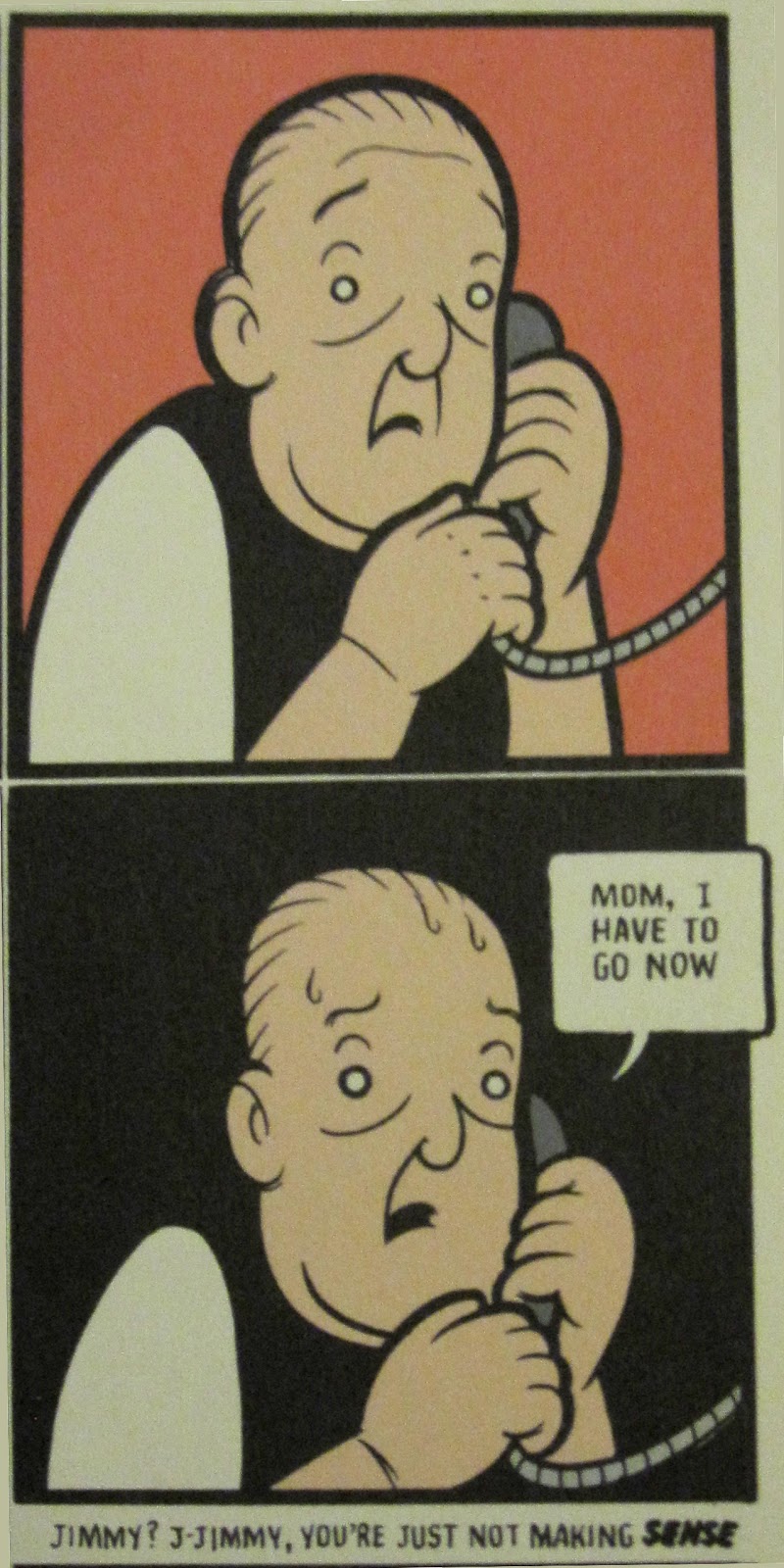
To try and explain: As all communication works as information ---------> Idea, so language works. Consequently, it is better to teach how language works in terms of this model than in terms of,say…
SVO.

Calm down super-hero man! Try not to react so emotionally. I'll give you some examples:
The most basic parcels of information can be stated as:
Something, someone, somewhere, sometime, someone's, some reason, somethings and somehow.
As well as: does something, doing something, did something and done something.These are the most basic building blocks of information. We think in these terms and language reflects that. It is important to note, however, that language is not taught according to these most basic of foundations.
Using the information---------> Idea model, we can understand the following basic relationship-
Information ----------------------------------------------------------------------------> Idea
Something a chair
Now, in Japan, this relationship is almost never taught, so that Japanese students quite naturally use the relationship that they know from Japanese:
Nantoka ----------------------------------------------> isu
which comes out as:
something -----------------------------------------------> chair
consequently, articles in English remain much more of a mystery than they necessarily have to be, simply because they are not taught according to the way they most basically work, that is to say, articles are part of, not seperate from the idea of something.

Yet people consistently learn their own language without one single visit to the linguistic zoo.
 |
| There's really no point crying. |
If you were to ask Lionel Messi exactly how he puts an opponent on the floor before precisely chipping in to score, it is unlikely that you would receive a satisfactory explanation. In the same way, native speakers of a language don't really understand how they do it.
So how do they** do it?
Observation of young infants suggests that they are constantly addressing what can be termed the something problem.*** All babies# are born into a forest of information, and their brains immediately attempt to sort things out. On the most basic level, even before language, there is a constant on-going effort to categorise things in terms of what is it?
At this point it is useful to note that, as adjectives are basically something, so the the question what is it? can produce ideas of good/bad, safe/scary, and delicious/not delicious as well as my mum/hunger, being held/ alone, food/not food.
From this, it follows that we structure our thoughts in the most basic way as:
(something) is (something)+
This is the way we think about things at the most basic level, even before language, and it is on this skeleton that the muscle of language fits. Nobody, at the most natural level, thinks in terms of SVO or articles or adjectives, and it is because of this that we can learn our native language without ever once worrying about the need to wrestle an Indo-european diphthong.
And so, the question is: Is this the way it works?++
I am going to answer: Yes. So that Tesol should, fundamentally be about basic information. Basic information that leads to basic ideas.
Which will then bring us, as unavoidable as is the sulphorous stench upon Lucifer's slags , to......

Join us+++ next time, for: Ideas in Tesol (2): The Whichfinder Specific !!
-------------------------------------------------------------------------------------------------------------------------
* Although, you probably shouldn't. But by putting it to one side, it is also still here.
** By they I mean us.
*** But probably shouldn't.
# Including the other animals.
+ It is interesting to note that, because communication is basically always: Info ----> Idea, we must necessarily make sentences basically as follows:
1. Information -------------------------------------------------------> 2. Idea
3, Description/explanation of connection
For example: 1. This --------------------------------------------------------> 2. a chair
3. is
Again, to emphasise the point. nobody thinks in terms of SVO. So why is it taught that way?
++ And if it isn't, then how does it work, would you say?
+++ Obviously, I'm saying this for my three regular readers, only one of whom is fictional.++++
++++ And none of whom are directly involved with Tesol. You see, one fascinating thing I have discovered about trying to discuss these things is that, generally, people outside Tesol, and more broadly, outside education are more likely to be willing to discuss these ideas.
Here are some genuine reactions from people involved with education/Tesol:
(School manager to me (angrily) : "I don't have to explain anything to you!"
(University Tesol teacher to me (in a personal e-mail) : "I will never read your blog!"
(Manager at the largest provider of private education in the world, on being asked by myself as to what is their definition of education): "Who the fuck has a definition of education?"
(More than one person on being asked to consider the most basic way communication works):
"I think if we understood how communication works we would lose the magic"
(Ofsted - UK Office of standards in education, on being asked, by e-mail, for their definition of education): "Ofsted does not have a definition of education."
(University lecturer in Communication on being asked, on his blog, if Info--->Idea might be a better way of looking at things): "..........." (no response)
(Ofsted - UK Office of standards in education, on being asked, by e-mail, how they manage to measure standards in education when they have no clear idea about what it is): "........" (no response).
(Manager of private company that has the task of finding volunteers from the local community to help children to read on being asked by myself, by e-mail, why they they refused my mum's application simply because she hadn't been to university (I assured them that she had taught me to read and reads very well, herself)): "........." (no response).
(Japanese Publisher of text-books when responding to my pitch of a basic text-book explaining how communication basically works with the title being: コミュニケーション道 (The way of Communication): "I don't want communication in the title".
Me: "Why not"
Pub. "It's too vague."
Me:" But the point of the book is to make it clearer."
Pub. "....." (No response.)
(TED representative on being asked to explain why "communication is basically the only thing we ever do"* is not an idea worth sharing): "....." (no reponse).
etc,etc.
* I think it is an idea worth sharing, but I have often been frustrated in my efforts to do so. My own idea from this information is that I should try harder.
"The task is not to see what has never been seen before, but to think what has never been thought before about what you see everyday."
Saturday, 5 January 2019
A whale is a tree; obviously.
When I was young enough to be sat in school within glancing distance of a small library space that was dominated by a Miffy Wendy house# and contained, in my opinion, far too many Miffy books, yet just old enough to be offended that people would think that I would want to read about Miffy; the cover of one book spoke louder than all of those that surrounded it and thoroughly intrigued me.
The title of this book was: Jonah and the Whale.
Of course, this title referred to the famous Bible story, but at that age (maybe I was five or six) I don't think I knew of it. What I did know was what a whale was: a massive fish*, and that Jonah was someone's name, probably because of Ken Reid's comic character: Jonah.
So, the book's cover was something that drew my interest because, I wondered, why did the cover show an illustration of a man sitting under a tree? It was similar to this:
Why didn't it show a man and a whale?
Indeed, it is the basic and traditional definition of madness that the idea does not follow from the information. For example, if you were to suggest that next door's dog was telling you to kill people, you can expect people to have a certain idea about that **
To see that the idea follows smoothly from the information is the basic
setting of all brains, all autonomic nervous systems; from jellyfish to djeli.
It' s fair to say, I think, that this is the way that everything most basically works, that this is most basic function of existence.
The most basic and important distinction between ourselves and the other animals is our increased capacity for communication. Our wizardry with the most basic skills of: asking/checking/describing/explaining has allowed us to, first of all, to give that biggest shining light in the night sky a name, then to ponder on its characteristics: goddess? Airless rock? Artificial construct? After that, we spin stories about going there and then we clamber up these webs made from dreams that are eventually strong enough to support the heavy lifting carried out by science, our better conversation with the universe. ( And when we reached the moon, what was the first thing we did?)
Once you start climbing Olympus you just carried on going, voyaging further into idea-space, and generally building dwellings amongst the gods and kings as they begin to slide down the scree of our efforts. But when you get that high off the ground there is always the temptation to shut your eyes and pretend it isn't happening. Information must be dealt with and new information can often be frightening.
For as much as human beings have this increased capacity to communicate, we also have the ability to ignore it and embrace the simple comforts of our most basic animal self, a dog that tries to shut out the voices in its head, unwilling and most often encouraged to ignore the stranger tapping at the window of its soul. The stranger who looks exactly like us.
And so it is that we can choose to ignore information to ensure the survival of the idea that makes us happy.
Although as a long-term survival policy, the flaws should be obvious, but then you would have to be interested in asking and checking in order to get more information, and culture, especially through education, has a strong tendency to inhibit communication rather than encourage it. All of this is a necessary survival strategy for the ruling powers, of course, and as we live in a culture that prizes blind consumption above all, it should not be that great a surprise that the information of President of the United States, whereas it used to give the idea of a statesman who might at least be prepared to describe and explain his own ideas it now dissolves into the nebulous realm of a snake-oil salesman who'll say anything to get you to buy his product. And once the idea of a President Trump becomes normalised then this itself becomes information that much more easily leads to the idea of a President West.
A whale is a tree; obviously.
Ignoring information, and the general lack of practice of asking and checking ensures that events can be easily spun by those with power towards any idea needed. Consequently:
Information ----------------------> Idea
Terrorist atrocity Let's invade Iraq.
carried out by
15 Saudi Arabians,
2 UAE, 1 Egyptian,
1 Lebanese.
If you have encouraged a society where people's most natural communicative tendancies have been firmly inhibited then this kind of thing is possible. Because in order to understand any information better you necessarily have to seek out connections. Of course you may have someone explain the connections to you, but the only way you are ever going to do this above dog-level is by asking and checking. And asking and checking as basic skills are largely anathema*** to standard education.
One very important reason for society to inhibit asking and checking is that the current massive industry of Marketing, and its business clients, depend on it. Oh yes, they are careful not to appear that way: Marketing is defined by the American Marketing Association as "the activity, set of institutions, and processes for creating, communicating, delivering, and exchanging offerings that have value for customers, clients, partners, and society at large." But it should be understood that for marketing "communicating" is one way woof-level stuff, where information is only there to engage with emotion, where slogans are drafted to appeal to our most basic ideas.
Information ---------------------------> Idea
Make America Great Ooh, sounds good.
Again
No questions are asked in order to ascertain precisely when and how and why America was great before. Questions that are necessary to better understand the idea.
It should also be noted that the Fourth Estate never made the slightest concerted effort to ask or check this idea. A fourth estate overwhelmingly consisting of the well-educated.
Anyway, in the spirit of all information depending on context, it is instructive to consider the following:

What ideas can come from this? That Reagan didn't do a good job? That there is nothing new under the sun? Or that dropping the "let's" and striking a more imperitave form indicates that Trump is simply intent on ordering people about?
Or maybe the idea of making America great again would be to network decent allies and productive partners, the kind we used to have:
President Reagan's special envoy to the Middle East Donald Rumsfeld is reminded of a friendly client.
Rumsfeld would later serve as Secretary of Defense in the George W. Bush administration, he played a major role in the invasion of Iraq.
Information ---------------> Idea
Invasion of Iraq (2003) "Mission accomplished"
- President Bush
or
In Iraq, the city of Mosul in the north of the country suffered first the American invasion and then increasing sectarian violence and an exodus of professional people until the inevitable rise of the hardest gang of bastards to fill the political vaccuum resulted in a government of Islamic State of Iraq and the Levant.
The Islamic State are, let's be clear, the most fundamental of fundamentalists. A gang whose activities even Al-Qaeda described as madness. Their reign of terror in Mosul was defeated in 2017 by Iraqi forces along with American, French and Kurdish forces.
Facing Mosul on the opposite bank of the Tigris, lies the ancient city of Nineveh. It was this city that Jonah was travelling to when he unexpectedly had to stay a few nights in his Cetacean Motel. It was here that God offered him the shade of the Kikayon tree.
It is said that the tomb of the prophet Jonah is also situated here. The tomb was a popular pilgrimage site[75] and a symbol of unity to Jews, Christians, and Muslims across the Middle East.[75] On July 24, 2014, the Islamic State of Iraq and the Levant (ISIL) destroyed the mosque containing the tomb as part of a campaign to destroy religious sanctuaries it deemed to be idolatrous.
Information -------------------------> Idea
What is correct? Our idea not yours.
Can I ask something? No.
Can I check your idea? No.
In the idea of the bible, Jonah sat outside Nineveh, in the shade of the Kikayon tree, awaiting its detruction. In another, he could have stepped outside his tomb and witnessed it.
Nineveh and its people have suffered greatly since the US+ invasion. Haliburton and its people have done very nicely from it. The prophet came to understand God's mercy. The profit showed none.
Jonah was swallowed by a whale. A preposterous story. But then; don't ask, don't check, and you can swallow anything.
A whale is a tree; obviously.
---------------------------------------------------------------------------------------------
# I am pleased to discover that it is called a Wendy house precisely because of its association with the character of Peter Pan. An association I had considered, but never knew to be true.+++
* It would be a few more years before, with some amazement, I discovered it was a mammal.
** It might also be predicted that they will think that you are deliberately trying to give them that idea.
***The word anathema has an interesting history.
**** The Hebrew text uses dag gadol which just means big fish++
+ Of course, it wasn't just America.
++ And, as has been often stated, a whale isn't a fish:
+++ It only took me forty five years to check that.
The title of this book was: Jonah and the Whale.
Of course, this title referred to the famous Bible story, but at that age (maybe I was five or six) I don't think I knew of it. What I did know was what a whale was: a massive fish*, and that Jonah was someone's name, probably because of Ken Reid's comic character: Jonah.
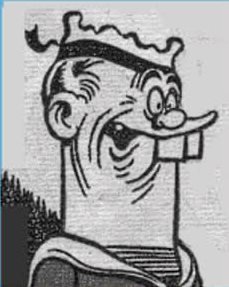 |
| Jonah-not the Biblical one |
 |
| Jonah...and...something. |
Why didn't it show a man and a whale?
For me, and I think the majority of publishers and illustrators, as well as any six year olds who might give it a moment's thought, it is an odd choice to not put a whale on the cover of a book that promises a whale as a main character. So much so, that my young mind couldn't accept the possibility that anyone would do this and automatically assumed that the tree in the picture must be the whale. I mean, why, on the cover of a book called Jonah and the Whale, would you not put a picture of Jonah and the Whale ?
So, therefore, it was obvious that the whale of the title was the tree the man was sitting under. What other logical conclusion could there be?
It was only many years later that I discovered that the tree in question does have an important role to play in the story of Jonah, as God first provides its shelter for Jonah from the blazing sun and then God takes it away in order to prove to Jonah a point about mercy (this is typical of the educational methods of The 2nd God). The plant in question is a Kikayon, so the story might well have been titled Jonah and the Kikayon. Except it wasn't, because what everybody remembers of the story of Jonah is that he get swallowed by a big fish. A fish as big as a whale****.
And so, my young self was presented with information and naturally produced an idea:
Information ----------------------> Idea
This is the way communication most basically works. What is important to understand is that all infomation depends on context, so that if we are missing context, then it will follow that our idea will be different. If I had known that the story of Jonah and the Whale was better described as The Story of Jonah and God, then a man sitting under a tree would not have come as that much of a surprise, as it would be relatively easy to step to ideas of Lord and mercy, protection and sustenance with the clear image of the tree. To take the step from a tree to a whale might well be described as Madness:
And so, my young self was presented with information and naturally produced an idea:
Information ----------------------> Idea
This is the way communication most basically works. What is important to understand is that all infomation depends on context, so that if we are missing context, then it will follow that our idea will be different. If I had known that the story of Jonah and the Whale was better described as The Story of Jonah and God, then a man sitting under a tree would not have come as that much of a surprise, as it would be relatively easy to step to ideas of Lord and mercy, protection and sustenance with the clear image of the tree. To take the step from a tree to a whale might well be described as Madness:
All aboard the nutty train.
Indeed, it is the basic and traditional definition of madness that the idea does not follow from the information. For example, if you were to suggest that next door's dog was telling you to kill people, you can expect people to have a certain idea about that **
To see that the idea follows smoothly from the information is the basic
setting of all brains, all autonomic nervous systems; from jellyfish to djeli.
It' s fair to say, I think, that this is the way that everything most basically works, that this is most basic function of existence.
The most basic and important distinction between ourselves and the other animals is our increased capacity for communication. Our wizardry with the most basic skills of: asking/checking/describing/explaining has allowed us to, first of all, to give that biggest shining light in the night sky a name, then to ponder on its characteristics: goddess? Airless rock? Artificial construct? After that, we spin stories about going there and then we clamber up these webs made from dreams that are eventually strong enough to support the heavy lifting carried out by science, our better conversation with the universe. ( And when we reached the moon, what was the first thing we did?)
Once you start climbing Olympus you just carried on going, voyaging further into idea-space, and generally building dwellings amongst the gods and kings as they begin to slide down the scree of our efforts. But when you get that high off the ground there is always the temptation to shut your eyes and pretend it isn't happening. Information must be dealt with and new information can often be frightening.
For as much as human beings have this increased capacity to communicate, we also have the ability to ignore it and embrace the simple comforts of our most basic animal self, a dog that tries to shut out the voices in its head, unwilling and most often encouraged to ignore the stranger tapping at the window of its soul. The stranger who looks exactly like us.
And so it is that we can choose to ignore information to ensure the survival of the idea that makes us happy.
Although as a long-term survival policy, the flaws should be obvious, but then you would have to be interested in asking and checking in order to get more information, and culture, especially through education, has a strong tendency to inhibit communication rather than encourage it. All of this is a necessary survival strategy for the ruling powers, of course, and as we live in a culture that prizes blind consumption above all, it should not be that great a surprise that the information of President of the United States, whereas it used to give the idea of a statesman who might at least be prepared to describe and explain his own ideas it now dissolves into the nebulous realm of a snake-oil salesman who'll say anything to get you to buy his product. And once the idea of a President Trump becomes normalised then this itself becomes information that much more easily leads to the idea of a President West.
A whale is a tree; obviously.
Ignoring information, and the general lack of practice of asking and checking ensures that events can be easily spun by those with power towards any idea needed. Consequently:
Information ----------------------> Idea
Terrorist atrocity Let's invade Iraq.
carried out by
15 Saudi Arabians,
2 UAE, 1 Egyptian,
1 Lebanese.
If you have encouraged a society where people's most natural communicative tendancies have been firmly inhibited then this kind of thing is possible. Because in order to understand any information better you necessarily have to seek out connections. Of course you may have someone explain the connections to you, but the only way you are ever going to do this above dog-level is by asking and checking. And asking and checking as basic skills are largely anathema*** to standard education.
One very important reason for society to inhibit asking and checking is that the current massive industry of Marketing, and its business clients, depend on it. Oh yes, they are careful not to appear that way: Marketing is defined by the American Marketing Association as "the activity, set of institutions, and processes for creating, communicating, delivering, and exchanging offerings that have value for customers, clients, partners, and society at large." But it should be understood that for marketing "communicating" is one way woof-level stuff, where information is only there to engage with emotion, where slogans are drafted to appeal to our most basic ideas.
Information ---------------------------> Idea
Make America Great Ooh, sounds good.
Again
No questions are asked in order to ascertain precisely when and how and why America was great before. Questions that are necessary to better understand the idea.
It should also be noted that the Fourth Estate never made the slightest concerted effort to ask or check this idea. A fourth estate overwhelmingly consisting of the well-educated.
Anyway, in the spirit of all information depending on context, it is instructive to consider the following:
Reagan Campaign button 1980
What ideas can come from this? That Reagan didn't do a good job? That there is nothing new under the sun? Or that dropping the "let's" and striking a more imperitave form indicates that Trump is simply intent on ordering people about?
Or maybe the idea of making America great again would be to network decent allies and productive partners, the kind we used to have:
President Reagan's special envoy to the Middle East Donald Rumsfeld is reminded of a friendly client.
Rumsfeld would later serve as Secretary of Defense in the George W. Bush administration, he played a major role in the invasion of Iraq.
Information ---------------> Idea
Invasion of Iraq (2003) "Mission accomplished"
- President Bush
or
"In a September 2007 interview
with The Daily Telegraph, General Mike Jackson, the head of the British army during the invasion, criticized Rumsfeld's plans for the invasion of Iraq as "intellectually bankrupt," adding that Rumsfeld is "one of those most responsible for the current situation in Iraq," and that he felt that "the US approach to combating global terrorism is 'inadequate' and too focused on military might rather than nation building and diplomacy."[70]
The idea that the invasion of Iraq would lead to chaos was barely discussed in the rush for loot, yet it was grimly predictable. Clearly, to get people to focus on vague ideas that appeal to the most basic of emotions takes standard marketing techniques. Get people to support something and then don't think too much about it ever again.
Information -----------------------------------------> Idea
Iraq, Christmas 2018 It's better now,
right?
with The Daily Telegraph, General Mike Jackson, the head of the British army during the invasion, criticized Rumsfeld's plans for the invasion of Iraq as "intellectually bankrupt," adding that Rumsfeld is "one of those most responsible for the current situation in Iraq," and that he felt that "the US approach to combating global terrorism is 'inadequate' and too focused on military might rather than nation building and diplomacy."[70]
The idea that the invasion of Iraq would lead to chaos was barely discussed in the rush for loot, yet it was grimly predictable. Clearly, to get people to focus on vague ideas that appeal to the most basic of emotions takes standard marketing techniques. Get people to support something and then don't think too much about it ever again.
Information -----------------------------------------> Idea
Iraq, Christmas 2018 It's better now,
right?
 |
| Christmas 2018. Mosul, Iraq. |
In Iraq, the city of Mosul in the north of the country suffered first the American invasion and then increasing sectarian violence and an exodus of professional people until the inevitable rise of the hardest gang of bastards to fill the political vaccuum resulted in a government of Islamic State of Iraq and the Levant.
The Islamic State are, let's be clear, the most fundamental of fundamentalists. A gang whose activities even Al-Qaeda described as madness. Their reign of terror in Mosul was defeated in 2017 by Iraqi forces along with American, French and Kurdish forces.
Facing Mosul on the opposite bank of the Tigris, lies the ancient city of Nineveh. It was this city that Jonah was travelling to when he unexpectedly had to stay a few nights in his Cetacean Motel. It was here that God offered him the shade of the Kikayon tree.
It is said that the tomb of the prophet Jonah is also situated here. The tomb was a popular pilgrimage site[75] and a symbol of unity to Jews, Christians, and Muslims across the Middle East.[75] On July 24, 2014, the Islamic State of Iraq and the Levant (ISIL) destroyed the mosque containing the tomb as part of a campaign to destroy religious sanctuaries it deemed to be idolatrous.
Information -------------------------> Idea
What is correct? Our idea not yours.
Can I ask something? No.
Can I check your idea? No.
In the idea of the bible, Jonah sat outside Nineveh, in the shade of the Kikayon tree, awaiting its detruction. In another, he could have stepped outside his tomb and witnessed it.
Nineveh and its people have suffered greatly since the US+ invasion. Haliburton and its people have done very nicely from it. The prophet came to understand God's mercy. The profit showed none.
Jonah was swallowed by a whale. A preposterous story. But then; don't ask, don't check, and you can swallow anything.
A whale is a tree; obviously.
---------------------------------------------------------------------------------------------
# I am pleased to discover that it is called a Wendy house precisely because of its association with the character of Peter Pan. An association I had considered, but never knew to be true.+++
* It would be a few more years before, with some amazement, I discovered it was a mammal.
** It might also be predicted that they will think that you are deliberately trying to give them that idea.
***The word anathema has an interesting history.
**** The Hebrew text uses dag gadol which just means big fish++
+ Of course, it wasn't just America.
++ And, as has been often stated, a whale isn't a fish:
+++ It only took me forty five years to check that.
Subscribe to:
Posts (Atom)
Ritual, Ideas, Relativity: How grammar got there before Einstein.
There is an idea that human culture first started with ritual . That repeated actions, given a sacred importance, allowed ...
.jpg)
-
 The fundamental organic process of communication, the instinctive process that forms the basis of the functions of the nervous system, the ...
 -
.jpg) "The only way we can begin to try to understand anything better is by asking+checking." If that statement is true, then you might...
"The only way we can begin to try to understand anything better is by asking+checking." If that statement is true, then you might... -
 Grok: Bela Lugosi’s pyramid is a critical thinking model that places the question "What is it?" at its apex, emphasizing asking...