Thursday, 11 July 2013

Ex-nymphs vs sex-crazed homos: Describing and Explaining.


                                                         What is it?

          The part of communication that is giving information can be most easily expressed as: Describing and Explaining. We describe and explain whenever we give information, and from this information there is an idea, because communication always, and most basically, works as:

                                             Information ---------> Idea

       
The information we choose to give affects the idea. We might describe former P.M. Tony Blair as "the right honourable", or we can describe him as "a war criminal." The musician Prince has been described as " a supernatural Martian playing at Euterpe's party" as well as "a paranoid little schizo with a bible in one hand and his cock in the other." And even such a relatively simple scenario as this-


        -may be a woodlouse, a butcher boy, or even a 団子虫(dango mushi) or dumpling bug in Japanese.  Would you rather have a louse or a dumpling bug in your house?
       
       All people are born with an innate desire to describe and explain. Without it we couldn't learn our native language. Education generally spoils this natural ability by having a deadening culture of the right answer. Things have become worse in the last couple of decades with the increasing emphasis on mulitiple choice tests-   http://www.edutopia.org/blog/dark-history-of-multiple-choice-ainissa-ramirez
  
     Here's a quick multiple choice test:
Q: The Sun is best described as:

A: A Star.
B. A god.
C. An organ.
D. A yellow dwarf.

    Yes, The Sun is a star. But it is also a god and an organ and a yellow dwarf. A vital aspect of communication is that all information depends on context. In different contexts, the Sun is all these things. Communication problems occur when people are connecting information to different contexts. This is why very basic communication practice involves defining terms.
    Here's George Carlin's perfectly sensible view of the sun: Sun God.


Looks like the Japanese were right all along !

   
   Fundamentalists of all kits, as well as despising Bela Lugosi, also dis-like describing and explaining.  We are told that: "God moves in mysterious ways" (so don't look for better explanations). We also hear very clear statements that in themselves demand more explanation because the idea that follows information is itself information that naturally leads to another idea. That's the way it works. Don't blame me, blame: god/evolution/explanation of choice.  
    For example: what could be more worthy of explanation than the reason why the United Kingdom needs nuclear weapons? Clearly, the ancient and wise Great Britain would find someone who would patiently go through all the necessary explanations to show people why they should spend their money on things that are built to do this-


-rather than spend the money on things that can do this-


         Clearly, it's a tricky choice that ordinary people can't be trusted with. The British democracy  entrusts this sacred choice with a member of the educated elite who can guide us through this maze. Do we want children burnt to hell or reading books? Luckily, here's Dave to show us the way- David Cameron: We need a nuclear deterrent more than ever
        As reading is now officially something not to be encouraged I'll go through the main points in Dave's explanation-

         We need a "nuclear deterrent" because countries like Iran and North Korea are a threat. North Korea is described as "aggressive".  Presumably, that's more aggressive than our good friend and invading partner the United States that has invaded many many more countries than North Korea in the last few decades. Of course, nobody asks for Dave's definition of aggression. That would entail better communication and people are educated not to do that.
         Also, there is absolutely no explanation why countries like Sweden and Brazil and Switzerland feel that they are fine without any nuclear weapons capability whatsoever. Moreover, there is no effort to explain the benefit any country would gain from attacking Britain with nuclear weapons anyway. If we decommissioned all our nukes tomorrow, would Russia immediately attack? If they wouldn't, then why do we have nuclear weapons ?
        
          How did we get to the point where we accept the feeble explanations of a shiny-faced toff as to why we should turn our ploughshares into swords ?
          The current economic system that Britain is a part of demands weak communication. If the power structures that we already have are to survive, they must ensure that people are not interested in asking and checking or demanding better describing and explaining.  This system results in an educated elite that are not taught how communication works but know enough about describing and explaining to realise that it serves the interests of those in power if communication is a one-way street.
           An excellent example of what can be done with top-down communication is in the BBC documentary The Century of the Self, which profiles "the father of the Public Relations industry" Edward Bernays-          http://www.youtube.com/watch?v=cW_rIdd69W8
   The Public Relations industry is essentially against better communication because it makes their job more difficult. They like simple describing and explaining that puts a simple idea into people's heads. They prefer very much that Bela Lugosi's coffin lid is nailed tightly shut. Modern politics and culture is broadly the same. With simple explanations you can show people ideas that appeal. All the while obscuring more useful information that would give us a more useful idea. It would have been useful information for many people in 1981 to know that members of  Thatcher's cabinet were idly suggesting plans like 'managed decline' for a major city like Liverpool. We only get to hear about it 30 years later. Who is this information being kept secret from? The Russkies? Or us?
       
          The information we give affects the idea. The world now has many more PR people who's job it is to manage information in order to present only certain ideas. Would you prefer ex-nymphs in your garden or sex-crazed homos? Of course, personal preference comes into it, and I don't doubt that some people will be intrigued by the idea of either  a garden full of rampant gays, or unemployed  goddesses. Or both.
           However, my own idea of this information is this-


             The cicada or せみ(semi) or, tree-cricket or, that thing that makes enormous racket, lives for years as a Nymph. It used to be considered Homoptera, which means "uniform-wings". Interestingly, this explanation is no longer considered good enough. New information became available and the idea has changed.
          You can look at the information of a cicada and get many ideas. You night consider them grotesque or soothing or annoying or interesting. But when a cicada emerges as an adult it has only a couple of weeks to find a mate. So it sings. A lot. Fair enough really isn't it? If you had as little time, you'd want to make some noise too wouldn't you?

              By the way, How do we ourselves define " little time."?


Wednesday, 3 July 2013

Bela Lugosi is everywhere unwell, and particularly poorly in Japan.


                        Blair/Thatcher - 21 years in power: absolutely barking.
                                         Bela Lugosi is unwell.


             The asking + checking (Bela Lugosi) parts of communication are almost everywhere most often greeted with garlic, crucifixes and sharpened stakes.  Asking + checking  is met not only with the anger of the pitch-forked mob, but also with the fury of the guy in the castle. Those in power recognise that any effort to communicate represents a danger to those whose privileged position must never be exposed to the examination of sunlight lest it turn to dust. Human history shows that an increase in the quality of society is fundamentally linked to an increase in communication. Without the asking and checking of science, we would have none of our modern technological comforts. Without the asking and checking of the heretics we would still be in mortal fear of the church. Without the asking and checking of ordinary people, we'd still be wondering how to control fire.
              It would be cold.
           
             Power structures everywhere can only exist with the support of those within them. This support is usually tacit as those in power generally see to it that education and culture do not encourage people to communicate. This is a normal and necessary function of the system.
             If education and culture were to encourage communication, then asking + checking would be seen to be a good thing, and would naturally lead to genuine efforts to describe + explain. Yet in education there is usually no simple effort to encourage questions. There is no push to grade students on their ability to ask and check, which is fully 50% of communication. There is no acknowledgement that asking and checking are fundamental  components of communication.
            In the general culture, we can see how valued asking and checking is by the esteem in which debate is held-   http://en.wikipedia.org/wiki/Debate
            In formal debates you are usually defending your position from attack and trying to convince others that your position is correct.. Like this, people's idea of high-level communication becomes no better than dogs woofing at each other. The important questions become: who did it louder? Who did it cuter? Who has the glossier coat? Televised political debates have rarely risen much above this as in formal debate there is absolutely no emphasis on trying to understand the other person's idea, and so no real attempt is made to communicate above dog-level.
           
People's communication becomes barking.

           As all communication always works as: Information -----------> Idea, the most basic and important function of asking and checking is to understand the idea.  If we are not trying to understand the other person's idea, then what are we trying to do? It's clear that fundamentalists of all coats represent problems in society, and it is also clear that these people have zero interest in the ideas of others. So why isn't it common practice for people to attempt to understand someone's idea before dismissing it?
      Here's an example from a conversation I have had recently with a Japanese student of English in my class. This student is a qualified tour guide, very capable of expressing himself in English-
          
Student.    Recently, there was a recommendation by Japanese business leaders                        that  correct English pronunciation is not so important....
                
       Me.    I agree. Japanese students are usually far too worried about style rather                   than basic information.                 

Student.    But if you don't have correct pronunciation communication is difficult.
          
       Me.    Well, it's impossible to communicate well if you are not trying to ask and
                check. It's these basic skills that are a million times more important than
               the idea of correct pronunciation.

Student.    Mm...Anyway, talking of pronunciation......

          It's clear here that the student is making no basic effort to understand my idea. That means, no basic effort to communicate. He is, of course, perfectly free to consider my idea to be rubbish, but I would appreciate him explaining why it is rubbish. How else am I going to learn?
          Basic communication is a more of a problem in Japan than in other places for the simple reason that Japanese culture discourages asking and checking even more than other cultures do. It is very common for Japanese to guess the other person's meaning rather than to ask them directly for more information. Also, Japanese are often encouraged by their culture to not articulate their ideas. Naturally, Japanese continue this approach when they attempt to communicate in another language. Unfortunately, with this attitude, the necessary practice for communication generally does not, and can not, happen. To take an example, in one of my classrooms recently a post-card sized strip of wall-paper had been taken from the wall. Quite naturally, I decided to fill that space with a demon trying to burst through from a parallel universe. This room is used for one-to-one lessons; of the next 30 students who came in, only 3 asked about the demon.
           If you are not prepared to comment on, or ask about, a small red imp attempting entry into the classroom from another dimension, then what do you deem worthy of communication?
        

                                                "Mark, Mark, let me in........"

        Another important point about asking + checking is that it's a vital part of the way we learn our native language. 
      Small children are born with the natural ability to ask and check. Small children, without any hesitation, try to get the information they need- what is it? when? where? is it ? and especially why? are asked with no prompting. And they are not copying adults, because adults are much more hesitant to ask questions.
      All of this means that asking + checking are innate parts of human communication. Children are born with the natural ability to ask and check yet it has largely been eroded by the time they become adults. In between, they go to school and are socialised according to the mores of the society. And society does not want too much communication. (However, according to Mrs Thatcher, there is "no such thing as society." A hugely interesting idea about which nobody asked or checked . As usual.)   

     Although there are important problems with asking and checking in Japan, we should  understand that problems with Bela Lugosi are a very basic human problem and not a specifically Japanese one. It's just easier to see in Japan.
      In my own country, Great Britain, we are in no state to feel superior about our communication skills because in Great Britain we are closing libraries. More than 200 in 2012.                 http://www.guardian.co.uk/books/2012/dec/10/uk-lost-200-libraries-2012
      More than 200 is also the number of nuclear weapons that Britain retains.
     
      We are closing the libraries and are prepared to upgrade our nuclear weapons.  Isn't this a clear symptom of a sick society, a society where Bela Lugosi is unwell  ? 

Wednesday, 26 June 2013

The Man who is Thursday- communication, creativity and The Mighty Snore.


                                       Asgard: remarkably dull, considering.

     The late film critic Roger Ebert described 2011's Thor as: "a failure as a movie, but a success as marketing". Indeed, with the talent involved and the basic interest from the fans of the comic it was never going to be a particularly difficult sell. Yet it was rubbish. It lacked almost anything of interest. Dull scene after dull scene ponderously dripped into the expensive production barrel which was then dutifully scraped.
     However, clearly a lot of people enjoyed it and Ebert also pointed out how well the film was doing on Rotten Tomatoes, so why bother to complain? Why not just set fire to the memory of it and let this dead film drift off to Valhalla? Because it could have been a whole lot better. Because Thor might have been mightier. Because with just a little understanding of creativity, we might have some shoots of wonder amongst this technically proficient but sterile tent-pole event. Something better.
       
     As everything basically works as: Information ----------> Idea, if you want to be creative then look for ideas that are interesting.   You're looking for something that the audience won't have thought of but that comes naturally from the basic information you're working with. To put it another way, when I read a story or watch a film I don't want to see something that I could have done.
    To take a simple example; if you are writing a story about Thor coming to Earth then one  connected idea would be that there is a day of the week named after this guy.  Why wouldn't someone mention this? How could a screen-writer not want to put it in to offer something better than the turgid interaction served up throughout ? You could play it straight or for laughs.  Would Thor know he had a day of the week named after him? Would he be pleased or annoyingly smug about it? Or would he have no knowledge of any of this and demand that all days of the week be named after him. Would he start complaining that Jupiter didn't exist? Or rage to discover that his father has the power of yesterday? Couldn't he possibly do something more interesting than get runover  or hit people ?
    Speaking of Odin, why not try and do something interesting with this character who, after all, is the god of magic! Instead of Anthony Hopkins phoning in the role from Port Talbot why not use this great actor to portray a more interesting character?  You might have Odin as a cosmic Keyser Soze who manipulates everybody and everything in order to rid Asgard of the Frost Giant threat. He anticipates what Loki will do, and what Thor will do in reaction to that, and the banishment to Earth is simply a way to train Thor to think outside the god-box; by coping with the ways of men he can use his new skills to out-wit the Frost Giants. Cosmic politics don't allow Odin to take action, so he must set up his pawns without appearing to be anywhere near the board. Any of this is more interesting than the basic "You were naughty Thor, and now you're grounded...on Earth!" we are subjected to. You might even want to suggest that there's a special reason why the seemingly omniscient Nick Fury wears an eye-patch.....
    Asgard itself appears as if designed by Albert Speer and the general Triumph of the Will aesthetic is matched by the specific Defeat of the Will experienced by the viewer. Wouldn't the whole realm, and film, have been  simply improved with a Gilliamesque tone? The Asgardians farting and carousing, attempting to outdo each other in feats of strength, as Odin looks on and mutters: "As above so below." Humans are rubbish because their gods are rubbish. Now there's an interesting idea.
   
   On Earth, the scientists who run into Thor are a pretty rubbish bunch as well. Natalie Portman, whose character seemingly is just a pretty face,  shows no interest whatsoever in the film's only interesting idea: "Where I come from, magic and science are the same thing." Now, if I were sitting listening to Thor say this, I would agree with him because everything is basically communication so therefore magic and science are the same thing. However, Ms Portman doesn't respond to this controversial concept largely because the movie needs to make space for Thor to beat some people up in a way we've seen a thousand times before.
  . As there is the god of thunder in their midst,there is also the missed opportunity for one of these scientists to comment on the fact that how lightning works is still largely a mystery. With that you could have Thor just say, "it works like this..." or alternatively you might have Thor smile and say: "I don't know either !"
    Overall, and as is usual in these kinds of movies, the scientists show surprisingly little interest in the living god now amongst them. It is possible that this scenario is just the result of a society that cares little for asking and checking, that is quite happy that Bela Lugosi is dead, but when the older male scientist  bizarrely disses the great science writer Arthur C. Clarke we can clearly see that the characters stupidity is directly connected to the writers'/producers' ignorance.
     Beyond that,  a great opportunity is blown for this scientist and Thor to have comical scenes in a bar. Are we presented with Thor wrestling with Karaoke? Or even a decent drinking competition? No and no. You put the god of thunder into a bar on Earth and nothing of note happens. You're really not trying very hard are you?
     Of course, the god of thunder's story was really brought to you by the god of money and he doesn't usually allow a good story to get in the way of profit. Naturally, his wrath was appeased by the success of the first movie and now Hollywood has strained itself to produce a new length of product. Thor 2 is on its way. 
    Surely there's a chance here to do something interesting ? With the basic information established that the Norse god Thor is real and on Earth, and has been clearly, to all news media,  helping to save the very world itself as part of the Avengers, what interesting ideas should be naturally following from all this?
   Shouldn't we have some interesting scenes where the Vatican and Pat Robertson and the Saudi government have to come to terms with the fact that god exists, and he's not theirs.  Inevitably, ordinary believers of all religions would start to worship Thor. Wouldn't they? Organised religion would be in a massive crisis. How would they deal with it? Make a deal with the Devil?

   Unfortunately, I think the new movie will have none of this, and more of Thor hitting people. I'd put money on it.


Friday, 21 June 2013

Moon River.


                                    Wherever you're going I'm going your way.        
         
         
                The murky brown waters of the canal near Yokohama Station contain a lot more action than the casual observer might at first notice. There`s the usual carp, but also some pied wagtails and the odd duck. Crabs claw a living from the concrete banks and very occasionally a lost frog will attempt the survival course of rusted bicycles and dead umbrellas.         
                All through the year the waters offer the opportunity to observe a rich variety of discarded plastic bags and pieces of paper, but right now, those who are not giving a second glance to the flapping white vinyl and sodden flyers will in fact be missing the chance to have a look at some real natural beauties. Because at this time of year the river is visited by Moon Jellyfish.        
               The Jellies arrive silently in the canal like lost aliens. I used to wonder why the Jellies decided to swim up the canal. Where were they going ? What did they want?  Was this phenomenon something like salmon who return to their spawning grounds?        
              In fact, I was missing some important information about Jellyfish in general that meant that my ideas were only so much nonsense, because it turns out that Jellyfish are just a nervous system without a brain and, as such, literally go with the flow. The Jellies don't want  to go up the canal, it's just where they end up. All the other Jellyfish who remain in Tokyo Bay probably have a much better time of it, although as they have no brains, those in the Bay never get the chance to feel that smug.
              Mind you, God/Evolution/Explanation of choice  has seen to it that the lack-of-brain situation has been silver-lined by the fact that the Moon Jellyfish has four gonads that are all shaped like horse-shoes. This can only be described as lucky.          
         Although having said that, I did observe once on the canal a Moon Jellyfish meet a terrible fate at the hands of a crab who, considering the usual pickings along the concrete banks, must have thought that Christmas had come early. 
         Now, I am well aware that most scientists would be in agreement that crabs do not celebrate Christmas, but it's always worth remembering that scientists have been wrong before.  In 1957, the Astronomer Royal of the U.K. Sir Harold Spencer Jones said that: "Space travel is bunk." Twelve years later, Neil Armstrong was taking his one small step.  In a world were we've been to the Moon, doesn't the idea of crabs celebrating the birth of Christ actually become more reasonable?       
         In the spirit of questioning, is there any evidence that crabs don't celebrate Christmas?    
         So for sceptics, I offer the following information and ask simply: Is there a better explanation for why crabs are so nuts about Christmas Island ?


        We easily anthropomorphosise. Certainly, it's easier to do than spell, but it's difficult to see that crab in the road on Christmas Island without thinking of a frustrated hitch-hiker or someone trying to cross a dangerously busy highway. Seeing ourselves in other creatures is the natural result of the human ability to communicate.       
        Last year, as I stood at the canal-side one day, I noticed a frog sitting forlornly on a rusting girder, possibly wondering about the strange nature of this hard brown log he'd found. I was surprised to see him there and wondered if  he would be able to find enough food to survive. I didn't think frogs ate much rust or plastic, so wanted to check on his progress every time I went past. As I left him, he was investigating an iron-oxide sump. It didn't look good.
        For a couple of weeks I didn't spot him and eventually hoped that he'd managed to hop off to a place that was more environmentally friendly to frogs. Maybe he'd managed to find a local pond. Maybe he'd even gone a courtin'!       
       And then he floated into view, his sad little corpse spinning slowly in midstream as the traffic sped overhead.
       Myself, the sole witness to this tiny little passion play, I wondered why I would get upset about a frog. There are any number of horrors in the world, why should I feel bad about a frog who'd....well....croaked?
       Simple empathy for a fellow struggler is a normal human idea. As explained by the character of Jacob in Will Eisner's A Life Force:


  The popularity of nature documentaries and the innate wonder we have for animals and plants and other natural phenomena indicates that one simple human desire is to understand the universe around us.
   This desire is the history of all philosophy, from the earliest religion to the latest science. One long and ongoing quest for explanations.
     And, as has long been a popular idea in Buddhism, meditation on the world around us gives us an insight into our true nature.
                 
 
    And the Moon Jellyfish go up the river, totally at one with their floating world, looking only for food and reproduction.
    Mindlessly going with the flow.
    Only to wash up on stoney shores to be easily picked apart by crabs.


Sunday, 16 June 2013

The Ofuna Escalator Mystery.

    When I first came to Japan I worked in Ofuna, a city about fifteen minutes from Yokohama by train. I would get the train back to Yokohama every evening,  Occasionally, an Anglo-Australian expeditionary force would reconnoitre such points of interest as the "Pub and Snack" whose neon sign promised familiar comforts.  Remarkably, this venue completely failed to contain a dart-board and a jar of pickled eggs on the counter. Instead, it seemed to be some fiendish kind of Japanese device for removing a substantial amount of money from foolish pockets for very little entertainment in return. Wiser but poorer, we were.
    All part of the normal learning process when moving to a new place, of course, but what would baffle me for over a year was nothing more complex than the station's escalator.

    Here's Ofuna Station and its escalator in 2013:
   
                                                 Ofuna station yesterday.
     
      The original escalator is on the far left, going up. More recently, the down escalator and the lift (or elevator if you prefer) have been added.
    If you happened to use the station after 10:30 p.m. you would find that the escalator had been stopped and you had to use the stairs. Right after the Tohoku Earthquake of 2011 it was normal to find stations without stopped escalators as there was a general drive to save energy.  Before that, any non-moving escalator in a station was broken. And all the other stations I used in my first year in Japan all had their escalators working until they closed, usually around 1 a.m., so why was Ofuna's escalator stopping at 10:30 ? Naturally, I asked Japanese people about this but got no answers. Nobody knew why this strange phenomenon occurred.
    Now, I appreciate that the "Ofuna escalator mystery" may seem like the dullest-ever episode of Columbo, but for me during my first years in Japan, it came to represent the basic question that most have when trying to cope with a different culture: are these people just mad?
    Resigning oneself to not understanding things is a choice that is overwhelmingly popular, the RUN DMC school of philosophy: It's like that, and that's the way it is.    At a party, after a decade in the country, I was telling a long-term English resident of Japan that I'd been here ten years when he quickly interrupted me with: "Oh that's the point at which you realise that you'll never understand anything here !". Not understanding anything about the place where he lived was seemingly of no concern to him, and naturally he didn't bother to check my opinion on the matter, happy as he was with his idea.

                                 Columbo: A pro- asking and checking to get to the
                                 bottom of the Ofuna Escalator Mystery. Possibly.

         However, the entirety of human history is about people making an effort to understand how things work. Everything we enjoy now is a result of people trying to understand how things work. And people are things.
         To understand others is to understand yourself. To see another culture is to see our own, albeit in a fun-house mirror. Yet if we don't understand our own culture, we will really have no good idea of what we are looking at. The chimpanzee who sees his reflection for the first time can't get over how funny the other fellow is. Look at that face!! Look at those antics !         
         In history, the propagandists, those government marketers, have usually been very keen for people not to understand others. It's a very handy tool.
         In order to get a better idea of anything we need better information, and not the information that those with an agenda are supplying us with. To get a better idea of other cultures we need to ask the run of Bela Lugsi's Pyramid to get the information we need.
         But if you ask the people who live in a culture to explain their own culture, they most often can not. And you are left with the idea that these people live in a place that doesn't make sense!
        
Which is not at all like our culture, is it?

                             
                                Pigeon: often seen loitering in Ofuna Station. What
                                did he know?

         Of course, understanding cultures is a lot more complex than understanding why an escalator stops at 10:30. But the basic principle is the same as ever:

                             (more) Info ------------> (more) Idea

          Why wouldn't we want a better idea about something?

          However and anyway and eventually; a long time after I'd started trying to get to the (metaphorical) bottom of this moving stair-case,  I received the information I needed, and it was elegant in its simple ability to illuminate:
        It wasn't Ofuna Station's escalator!        The simple fact of the matter was that the escalator belonged to the department store right next to the station. The department store that closed at 10:30.
        With this knowledge I could breathe a long sigh of relief. The situation made sense now, and  I wasn't in a land where you can't possibly know why things happen. With better information you can understand things for that's how communication works.
       No wonder those in power guard information so zealously.
      
       And by the way, that English guy who was quite happy not to understand anything? He worked in marketing.


Wednesday, 12 June 2013

Bela Lugosi is alive.

     50% of communication is, most basically, asking and checking ( most usually referred to as: Bela Lugosi ).
        In schools, how often are students graded on their ability to ask questions? How often are they tested on their ability to check? Clearly, the usual education systems see no real value to communication as they ignore half of what it takes for it to be most effective.
        Here's Bela with some interesting ideas about life:

       
        Why is asking and checking so vital to communication? Because communication always works like this:
                            
                                       Information -------------> Idea


      Any information gives an idea. And any information can always give more than one idea. Naturally then, we will often need to ask and check in order to try to better understand the idea.    As an example let's take this statement from former British Prime Minister Tony Blair to a Labour Party conference in 1996: "Ask me my three priorities for government and I tell you: education, education,education."
        This information, like any information, leads to ideas. So did the audience at the party conference, which mostly consisted of University graduates, ask and check in order to better understand Tony's idea? Did anybody ask him for his definition of "education"? Or did they rise like the front rows of a Bros concert and give him a standing ovation?
         It's not difficult to guess what happened if we consider how "educated" people are generally trained not to ask and check about certain basic things.
          Tony got into power, and nearly 20 years later his idea of "education" still has the consistency of Dracula in gaseous form. We are not allowed anything solid, for then we might be able to understand the idea and could do something about it.

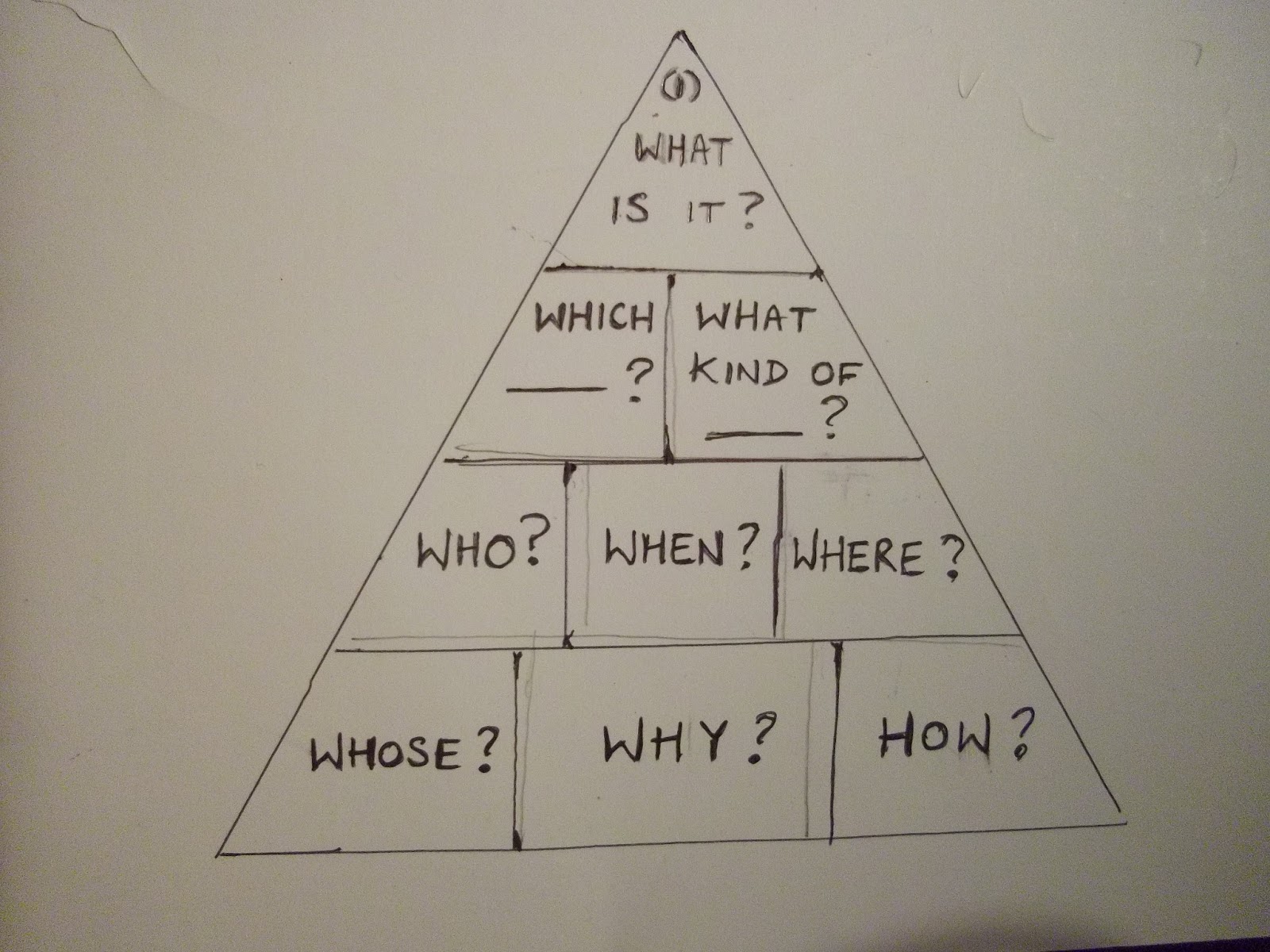
                                          Bela Lugosi's pyramid.

          The universe, and everything in it, most basically consists of information. And all that information can be simply expressed like this:

                                                
           If we wish to try to understand anything, then we need the information in Bela's pyramid.
           It always starts with: "What is it?" Yet, as we are usually not encouraged to ask, the simple and natural desire to find out what something is, is often squashed, and people are often left with ideas that are simply presented to them. Ideas that usually don't help us understand much.
           To take the simple example of Gaza; in order to have a better idea of the problems there, we would first need to understand what it is. Is it a place where nut-cases fire AK-47s randomly into the air, or is it "the world's largest open-air prison"?
           It is an interesting exercise to actually ask  people what they think things are, as it quickly becomes clear that people don't often apply the simple question: "What is it?" to the information that rolls across our screens.
           But never fear, for the great Tony Blair, that good Christian man, is a special peace envoy to the Middle East!
           Hang on... he's a war criminal isn't he? Or is he?
           A war criminal? What is it? Surely it's not one of us?

           Definition of terms is a corner-stone of critical thinking and the question, what is it? is at the apex of Bela Lugosi's pyramid. If we are to make any serious effort to understand anything at all, we need to find the information in the pyramid. Finding that, we can have a better idea whether someone like Tony Blair is a great man, a war criminal, or just some kind of dangerous vampire. Hmm... perhaps the stakeholder society is a good idea.
           
           But of course, because any information gives many ideas, there's always another opinion. Here's another, more musical, view of Bela Lugosi:


Tuesday, 11 June 2013

Obama and communication.

http://adage.com/article/moy-2008/obama-wins-ad-age-s-marketer-year/131810/

      In 2008 the Obama campaign won Advertising Age's Marketer of the Year award. Apple and Nike were among the giant corporations whose marketing campaigns were deemed by professionals in the industry to be less effective than Obama's.
      Marketing  is generally defined as "the process of communicating the value of a product or service to customers, for the purpose of selling the product or service. It is a critical business function for attracting customers."
      It is clear that when marketing is "communicating" it is the kind of communication where asking and checking are discouraged. We receive information that is designed to give us a particular idea. And so, when Obama promised "hope" and "change" people tended to wave their flags and weep rather than asking: "hope for what?" or "what kind of change?". The campaign was designed to spark the normal human idea that things can be better and, quite naturally if not asking and checking, people went along with it.
      But what kind of service was Obama really offering?
      As all communication most basically works as: INFO----> IDEA, then to get more of an IDEA about anything, we need more INFO. Useful information to know about the Obama campaign in '08 is that it collected more money from Wall Street than the McCain campaign:
     http://uk.reuters.com/article/2008/06/05/analysis-shares-obama-idUKNOA53525520080605
      It's interesting to note that this Reuters article explains this situation as "investors want to simply back the eventual winner" rather than explaining it as "big business is in bed with politics, and ordinary people simply get to choose which branch of the elite takes power."
      In short, Obama was always going to serve the interests of big business and the powerful elite. That wouldn't really serve as an effective advertising slogan, though.

      Here's an alternative view of marketing-

  
       The recent whistleblowing by Edward Snowden illustrates an important aspect of the Obama administration's attitude towards communication.: We control information, not you. We will look at your information whilst keeping ours in the dark. And when we can get away with it we will get the clubs out and batter people to death.
        Force is a very powerful tool of communication and has been used throughout history by people who want to get their own way without bothering with that tiresome communicative baggage that humans carry with them. Much easier to use your animal mode and start to hit people. Do not ask any questions. Do not check. Explain things in a way that makes you feel better about what you are doing.
       That way, it becomes easier to do stuff like this:
http://www.policymic.com/articles/16949/predator-drone-strikes-50-civilians-are-killed-for-every-1-terrorist-and-the-cia-only-wants-to-up-drone-warfare
             
       If we disagree with people, we kill them. And anyone who wanders into shot. This manic tendency towards violent communication and away from possible human communication is an inevitable consequence of an economic and political system that can only survive by stifling the natural human capacity to communicate.
       But let's pretend otherwise, because there's profit to be made.
        

Erm, so...how does language fundamentally work? - -----------------------------> Fuck all that we've gotta get on with these!

                                                Judge Dredd might not know a lot about art,                                               bu...